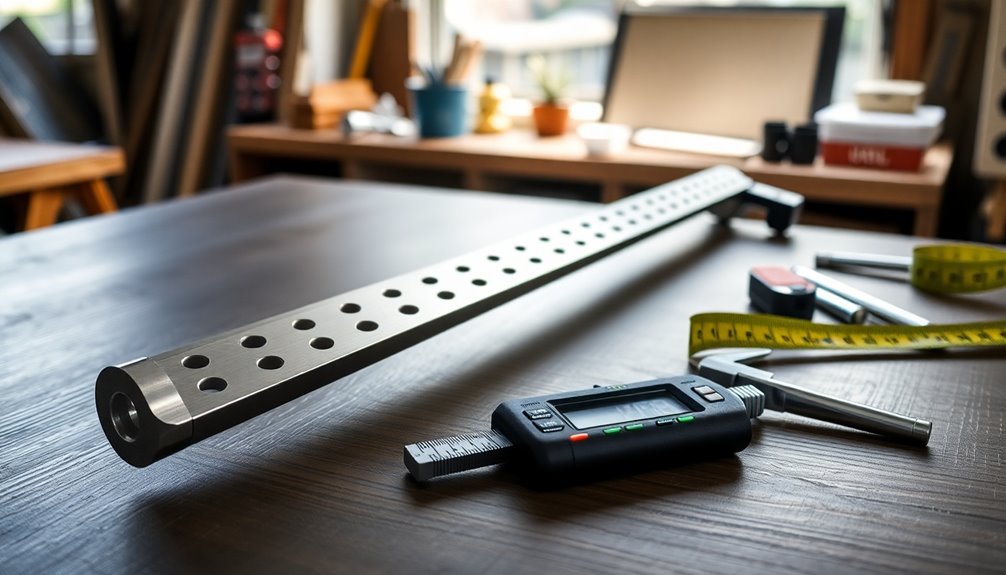

To design a spreader bar, you need to focus on load distribution, material selection, and structural design. Start by choosing durable materials that meet safety standards. Calculate the center of gravity for balanced lifting and consider dynamic loads and slinging angles. Choose a design that optimizes strength while minimizing weight. Finally, validate your design through manual calculations and stress assessments. Keep going to discover more details on each step and guarantee a safe and effective design.

Get furniture and decor delivered free with Prime
- Fast, free delivery on millions of items
- Prime Video, Amazon Music and more included
- Member-only deals all year
Key Takeaways
- Select appropriate materials that are field weldable, ductile, and comply with safety standards like ASME BTH-1 and ASME B30.20.
- Design for load distribution by calculating the center of gravity and ensuring balance during lifting operations.
- Consider dynamic loads and slinging angles to avoid exceeding safety factors and maintain stability.
- Explore design variations such as I-beams or channel sections, optimizing for manufacturability and weight reduction while ensuring strength.
- Validate your design through manual calculations and computer simulations, ensuring stresses remain within allowable limits for safe operation.

When you're designing a spreader bar, it's essential to understand how it distributes loads evenly during hoisting operations. This is important for reducing stress on the lifting points and minimizing the risk of instability or failure. A spreader bar, or lifting beam, is engineered specifically for this purpose, and its design can greatly influence the safety and effectiveness of your lifting operations.
To begin, selecting the right materials is necessary in the spreader bar design process. You'll want materials that are field weldable, ductile, and cost-effective, while also guaranteeing compliance with relevant safety standards like ASME BTH-1 and ASME B30.20. These standards help maintain safety and performance, making them imperative to your design.
Next, you'll need to take into account dynamic loads, slinging angles, and the center of gravity (CoG) of the load. Accurately calculating these elements is essential to maintaining balance and guaranteeing effective lifting without exceeding safety factors. Remember, a well-balanced load is key to reducing the risk of accidents during hoisting operations.
The design of the spreader bar can vary greatly, with options including I-beams or channel sections. Each design comes with its own set of advantages and disadvantages. Optimizing the design through iterative processes can help enhance manufacturability while reducing weight without compromising strength. You'll want to strike a balance between these factors to create a spreader bar that performs well under stress.
It's also important to perform manual calculations to validate your design against computer simulations. While software can provide valuable insights, manual checks confirm that factors such as compressive, bending, and shear stresses fall within allowable limits for safe operation. This step is imperative in confirming that your spreader bar can handle the loads it's designed for.
Frequently Asked Questions
What Are the Dimensions of a Spreader Bar?
When you're considering the dimensions of a spreader bar, think about the load's width and center of gravity.
Typically, you'll find lengths ranging from 6 to 20 feet, while heights sit around 6 to 12 inches. Widths generally vary between 4 to 12 inches.
Don't forget about the pad eyes; they usually range from 2 to 4 inches in diameter, tailored to fit your specific sling or connector for peak performance.
What Is the Structure of a Spreader Beam?
A spreader beam features a central structural member, often shaped like an I-beam or channel, which gives it strength to handle loads.
You'll find attachment points at both ends for connecting slings or lifting devices, ensuring stability during operations.
The beam's design resists bending and lateral-torsional buckling, making its structural integrity essential.
Depending on your lifting needs, you can customize the size and shape to suit different load requirements effectively.
Do Spreader Bars Need to Be Certified?
Yes, spreader bars need certification to guarantee they're safe and effective.
You'll find that organizations like ASME and OSHA set specific standards that these devices must meet.
Certification involves rigorous proof testing, where the bar is tested at 125% of its rated load capacity.
How Many Rigging Points Are Used With a Spreader Beam?
Imagine a bridge connecting two shores, holding everything in perfect balance.
With a spreader beam, you typically use two rigging points, one at each end. However, depending on your load and its requirements, you might need three or four points for better control.
Just remember to align those points with the load's center of gravity to prevent tipping. Keeping the sling angles under 45 degrees guarantees you maximize efficiency and safety.
Conclusion
To conclude, designing a spreader bar can be a simple yet satisfying project. By blending basic principles of balance and strength, you'll create a sturdy structure that serves its purpose effectively. Remember, meticulous measurements and mindful materials make all the difference. So, seize the opportunity to showcase your skills and craft a clever, custom creation. With a little dedication, you'll transform your vision into a tangible triumph, ensuring safety and stability in your setup.
Halloween Picks
halloween
As an affiliate, we earn on qualifying purchases.