Choosing the right video doorbells requires balancing image clarity, power source, and ongoing subscription costs. For most homeowners, the Ring Battery Doorbell 2K (2nd Gen) offers the best blend of ecosystem integration and ease of installation, while the Google Nest Doorbell (Wired, 3rd Gen) stands out for its superior 2K HDR video and native smart home compatibility. The primary tradeoff in this category is between convenience and control: wireless models offer flexible placement but require frequent charging, whereas wired units provide constant power but demand a compatible existing chime. As you read through this roundup, you will see how specific features like head-to-toe vision and local storage options differentiate these top contenders for different living situations.

Get furniture and decor delivered free with Prime
- Fast, free delivery on millions of items
- Prime Video, Amazon Music and more included
- Member-only deals all year
Complete the kit


Key Takeaways
- Wired models consistently deliver higher resolution and more consistent frame rates than their battery-powered counterparts, making them better for capturing fast-moving subjects.
- Subscription-free options exist but often sacrifice cloud history length or advanced motion detection features, forcing users to rely on local SD card storage.
- The Ring and Google ecosystems dominate the market, meaning cross-compatibility with other smart home devices is often more important than raw camera specs.
- Battery life is heavily dependent on local climate and motion traffic volume, with cold weather reducing performance by up to 40% in unheated entryways.
- Wide-angle lenses (160+ degrees) reduce blind spots at the door but can introduce fish-eye distortion that makes facial recognition difficult at extreme edges.
| Ring Battery Doorbell 2K (2nd Gen), Matte Mocha |  | Best for Detailed Battery-Powered Video | Video resolution: Retinal 2K | Zoom: Up to 6x Enhanced Zoom | Field of view: 140° horizontal, 140° vertical | VIEW ON AMAZON | See Our Full Breakdown |
| Wyze Battery Video Doorbell with Color Night Vision |  | Best for Flexible Power and Local Recording | Resolution: 1536 × 1536 | Field of view: 150° × 150° | Power: Rechargeable battery or hardwired | VIEW ON AMAZON | See Our Full Breakdown |
| Blink Video Doorbell + Outdoor 4 Wireless Security Cameras System |  | Best for Extending Coverage Beyond the Door | Doorbell resolution: 1440 × 1440p | Outdoor 4 resolution: 1080p HD | Field of view: 150° doorbell; 143° diagonal Outdoor 4 | VIEW ON AMAZON | See Our Full Breakdown |
| BOIFUN Wireless Video Doorbell Camera 2K HD with No Subscription | 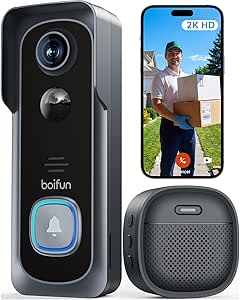 | Best for Subscription-Free Local Security | Resolution: 2K HD | Field of view: 166° | Night vision: HDR with 940 nm IR, up to 10 meters | VIEW ON AMAZON | See Our Full Breakdown |
| Google Nest Doorbell (Wired, 3rd Gen) – 2K HDR, Snow |  | Best Wired Pick for Google Home | Model: GA09967-US | Video resolution: 2K HDR (2000) | Field of view: 166° | VIEW ON AMAZON | See Our Full Breakdown |
| Tapo D225 2K+ Smart Video Doorbell with Chime |  | Best for Flexible Installation and Local Storage | Video resolution: 2K QHD | Field of view: 180° head-to-toe | Power: Built-in 10,000 mAh battery or 8–24 V hardwired | VIEW ON AMAZON | See Our Full Breakdown |
| Ring Wired Doorbell Pro (3rd Gen), 4K, Deep Silver |  | Best for Wired 4K Detail | Generation: 3rd Gen | Video: 4K with adaptive night vision | Zoom: Up to 10x enhanced zoom | VIEW ON AMAZON | See Our Full Breakdown |
| Orbitell 1080p Wireless Video Doorbell Camera |  | Best for Simple Person Alerts | Model: M52 | Video resolution: 1080p | Connectivity: 2.4 GHz Wi-Fi | VIEW ON AMAZON | See Our Full Breakdown |
| Ring Battery Doorbell 2K (2nd Gen), Speckled Gray | | Best for Subscription-Friendly Ring Households | Video resolution: Retinal 2K | Zoom: Up to 6x enhanced zoom | Field of view: 140° horizontal and 140° vertical | VIEW ON AMAZON | See Our Full Breakdown |
| Arlo Video Doorbell 2K (2nd Gen), Wireless or Wired, 1 Camera |  | Best for Broad Smart-Home Compatibility | Video resolution: 2K | Field of view: 180° | Power options: Rechargeable battery or wired trickle charging | VIEW ON AMAZON | See Our Full Breakdown |
| video doorbell | Field of view | Power | Connectivity | Video resolution |
|---|---|---|---|---|
| Ring Battery Doorbell 2K | 140° horizontal, 140° vertical | Built-in lithium-ion battery | Wi-Fi 4, 2.4 GHz single band | Retinal 2K |
| Wyze Battery Video Doorbell wi | 150° × 150° | Rechargeable battery or hardwired | — | — |
| Blink Video Doorbell + Outdoor | 150° doorbell; 143° diagonal Outdoor 4 | 3 AA lithium batteries for doorbell; 2 AA lithium batteries per Outdoor 4; Sync Module Core uses 5V DC | Wi-Fi 2.4 GHz 802.11b/g/n | — |
| BOIFUN Wireless Video Doorbell | 166° | — | — | — |
| Google Nest Doorbell | 166° | Corded electric | Wired, Wi-Fi | 2K HDR (2000) |
| Tapo D225 2K+ Smart Video Door | 180° head-to-toe | Built-in 10,000 mAh battery or 8–24 V hardwired | — | 2K QHD |
| Ring Wired Doorbell Pro | 140° horizontal × 140° vertical | Hardwired | Wi-Fi 6, dual-band 2.4 GHz/5 GHz | — |
| Orbitell 1080p Wireless Video | — | — | 2.4 GHz Wi-Fi | 1080p |
| Ring Battery Doorbell 2K | 140° horizontal and 140° vertical | Built-in lithium-ion battery | Wi-Fi 4, single-band 2.4 GHz | Retinal 2K |
| Arlo Video Doorbell 2K | 180° | — | 2.4 GHz Wi-Fi | 2K |
More Details on Our Top Picks
Ring Battery Doorbell 2K (2nd Gen), Matte Mocha
The Ring Battery Doorbell 2K suits shoppers who want sharper recorded detail without adding doorbell wiring. Its 2K video and up to 6x Enhanced Zoom can help make distant activity easier to inspect, while the 140° view covers both horizontal and vertical space around the entry. Compared with the Wyze Battery Video Doorbell, Ring offers higher stated resolution and zoom, while Wyze counters with a wider 150° field of view and local recording via a separately purchased microSD card.
The tradeoff is that this Ring relies on a built-in rechargeable battery, so it needs periodic charging, and a USB-C cable is not included. Some video history and AI features also require a separate subscription. Its 2.4 GHz-only Wi-Fi and bandwidth-dependent resolution may matter in homes with weak coverage near the front door.
Pros:- Retinal 2K video with up to 6x Enhanced Zoom
- 140° horizontal and vertical field of view
- Two-Way Talk, Live View, and real-time motion alerts
- Rechargeable battery avoids doorbell wiring
Cons:- USB-C charging cable is not included
- Some video history and AI features require a paid subscription
- Built-in battery must be recharged, and resolution can vary with internet bandwidth
Best for: Renters or homeowners who want detailed, zoomable doorbell footage without installing wired power and are comfortable recharging a built-in battery.
Not ideal for: Buyers who want local recording without a subscription, a removable battery, or a wider 150° view; the Wyze Battery Video Doorbell better matches those priorities.
- Video resolution:Retinal 2K
- Zoom:Up to 6x Enhanced Zoom
- Field of view:140° horizontal, 140° vertical
- Audio:Two-Way Talk
- Power:Built-in lithium-ion battery
- Charging:USB-C; cable not included
- Connectivity:Wi-Fi 4, 2.4 GHz single band
- Dimensions:2.11 × 5.78 × 1.41 in
Our verdict“Choose this Ring if zoomable 2K footage and battery-powered installation matter more than subscription-free storage or less frequent charging.”
Wyze Battery Video Doorbell with Color Night Vision
The Wyze Battery Video Doorbell stands out for offering both rechargeable-battery and hardwired installation, making it a practical fit for a wider range of entryways than battery-only choices such as the BOIFUN Wireless Video Doorbell. Its 150° × 150° view is wider than the Ring Battery Doorbell 2K’s 140° view, which can help capture packages and activity near the edges of the frame. Color night vision and two-way audio add useful context after dark.
Wyze also allows local recording to a microSD card, so cloud storage is optional rather than the only route to saved footage. That flexibility comes with extra setup: the card is sold separately, and chime devices are also separate purchases. The stated battery life is up to six months, shorter than the Blink system’s claimed two years, but Wyze’s dual-power option avoids relying on batteries if existing wiring is available.
Pros:- 150° × 150° field of view can cover the doorway and nearby package area
- Can run on a rechargeable battery or be hardwired
- Color night vision and two-way audio
- Local recording is available with a separately purchased microSD card
Cons:- microSD card is sold separately
- Chime devices are sold separately
- Up to six months of battery life is less than Blink’s stated two-year system life
Best for: Households that want a broad entry view, color night vision, and the choice between battery power and existing doorbell wiring.
Not ideal for: Buyers seeking a complete out-of-box setup with a chime or included local-storage card, or those prioritizing the longest stated battery life.
- Resolution:1536 × 1536
- Field of view:150° × 150°
- Power:Rechargeable battery or hardwired
- Battery life:Up to 6 months
- Night vision:Color
- Storage:microSD card up to 256 GB; card sold separately
- Audio:Two-way audio
- Compatibility:Alexa, Google Assistant, IFTTT
Our verdict“Pick Wyze if you want installation flexibility and optional local recording, and do not mind sourcing a card and chime separately.”
Blink Video Doorbell + Outdoor 4 Wireless Security Cameras System
This Blink bundle is the most useful pick here for shoppers who need more than a camera at the entrance: it pairs a 1440 × 1440 doorbell with Outdoor 4 cameras, extending monitoring to other parts of the property. The doorbell’s 150° field of view is broader than the Google Nest Doorbell (Wired, 3rd Gen)’s 166° figure only in the sense of system coverage; the Nest’s single camera instead offers higher-resolution 2K HDR footage at the door. Blink’s clearest advantage is its up to two-year battery life from included lithium batteries, reducing routine charging or replacement.
Night monitoring uses infrared rather than the Wyze doorbell’s color night vision, and Blink’s HD resolution is less detailed than the 2K options in this roundup. Cloud storage and advanced features rely on a Blink Subscription Plan, so buyers wanting subscription-free saved clips should look at Wyze or BOIFUN. This is a broader security package, not the sharpest standalone doorbell.
Pros:- Includes a second-generation doorbell and Outdoor 4 cameras
- Up to two years of battery life with included lithium batteries
- Doorbell offers a 150° field of view and 30 FPS video
- Infrared night vision and enhanced motion detection
Cons:- Cloud storage and advanced features require a Blink Subscription Plan
- Infrared night vision does not provide color footage
- The doorbell’s 1440 × 1440 resolution is below the 2K options in this lineup
Best for: Homeowners who want a doorbell plus several battery-powered outdoor camera viewpoints and prefer infrequent battery changes.
Not ideal for: Buyers focused on the highest-resolution doorbell footage, color night vision, or cloud storage and advanced features without a subscription.
- Doorbell resolution:1440 × 1440p
- Outdoor 4 resolution:1080p HD
- Field of view:150° doorbell; 143° diagonal Outdoor 4
- Frame rate:30 FPS
- Power:3 AA lithium batteries for doorbell; 2 AA lithium batteries per Outdoor 4; Sync Module Core uses 5V DC
- Battery life:Up to two years
- Connectivity:Wi-Fi 2.4 GHz 802.11b/g/n
- Operating temperature:-5°F to 113°F (-20°C to 45°C)
Our verdict“Choose this Blink bundle when adding outdoor camera coverage matters more than having the sharpest or most subscription-independent doorbell footage.”
BOIFUN Wireless Video Doorbell Camera 2K HD with No Subscription
The BOIFUN makes the strongest case for buyers who want core doorbell monitoring without committing to a cloud subscription. Its 2K HD video and 166° field of view give it a wide view of the entrance, while local microSD storage lets owners save footage on their own card. Compared with the Ring Battery Doorbell 2K, BOIFUN emphasizes local storage and a broader stated viewing angle; Ring offers up to 6x Enhanced Zoom, which may be more useful when inspecting distant details.
BOIFUN also includes human detection and an anti-theft alarm, but its battery is non-removable and lasts up to 60 days under laboratory conditions. That means more frequent charging than the Blink system’s claimed two-year battery life. The doorbell uses only 2.4 GHz Wi-Fi, and local recording requires a microSD card, so buyers should factor in both network coverage and card setup.
Pros:- 2K HD video with a 166° field of view
- Core features do not require a subscription
- Supports local recording on microSD cards up to 128 GB
- Human detection, motion alerts, and anti-theft alarm
Cons:- Works only on 2.4 GHz Wi-Fi
- Non-removable battery may need recharging as often as every 60 days under laboratory conditions
- Local recording depends on a separately sourced microSD card
Best for: Homeowners who want a wide-view wireless doorbell with local footage storage and no required subscription for core features.
Not ideal for: People who need 5 GHz Wi-Fi, a removable battery, or a long interval between recharges; the Blink system is a better fit for minimizing battery upkeep.
- Resolution:2K HD
- Field of view:166°
- Night vision:HDR with 940 nm IR, up to 10 meters
- Wi-Fi:2.4 GHz only
- Battery life:Up to 60 days under laboratory conditions
- Storage:microSD cards up to 128 GB
- Installation:No-drill, quick setup
- Additional features:Two-way audio, human detection, motion alerts, anti-theft alarm
Our verdict“Choose BOIFUN if subscription-free local recording and a wide view matter more than removable batteries or extended time between charges.”
Google Nest Doorbell (Wired, 3rd Gen) – 2K HDR, Snow
The Google Nest Doorbell (Wired, 3rd Gen) is the clearest choice for a Google Home household that wants a permanently powered camera and 2K HDR video. Its 166° view and night vision cover a broad area around the entry, while Google Home and Gemini features can add intelligent alerts and video summaries. Unlike the battery-powered Ring and BOIFUN models, it avoids routine recharging, making it a better fit for owners with compatible doorbell wiring who want a fixed installation.
That wired setup is also the main limitation: renters or homes without suitable wiring may find it impractical. Some Gemini features require a separate Google Home Premium subscription. Compared with the Blink bundle, Nest focuses on higher-resolution doorbell footage and smart-home integration rather than providing extra outdoor cameras. Buyers seeking a battery option or local microSD recording should look at Wyze or BOIFUN instead.
Pros:- 2K HDR video with a 166° field of view
- Wired power avoids battery charging and replacement
- Night vision for monitoring after dark
- Works with Google Home and Gemini features
Cons:- Requires wired installation
- Some Gemini features require a Google Home Premium subscription
- Does not offer the battery-powered installation flexibility of Ring, Wyze, or BOIFUN
Best for: Google Home users with existing doorbell wiring who want a continuously powered, 2K HDR camera with intelligent alert features.
Not ideal for: Renters, homes without compatible wiring, or buyers who want a battery-powered installation or local microSD recording.
- Model:GA09967-US
- Video resolution:2K HDR (2000)
- Field of view:166°
- Night vision:Yes
- Power:Corded electric
- Connectivity:Wired, Wi-Fi
- Dimensions:5.16 × 1.65 × 1.14 in
- Included components:Base plate and wedge, spacers, mounting hardware, wire connector, chime connector, and hex key
Our verdict“Choose Nest if you have doorbell wiring and use Google Home, but skip it if you need a wireless installation.”
Tapo D225 2K+ Smart Video Doorbell with Chime
The Tapo D225 is a strong fit if I want a wide entryway view without committing to hardwiring: its 180° head-to-toe view covers more vertical space than the Ring Wired Doorbell Pro’s 140° × 140° view, and it records in 2K QHD. I can use the rechargeable battery or connect it to compatible wiring, while the included indoor chime means alerts needn’t depend solely on a phone. Person, package, and vehicle detection also make its motion alerts more specific than the Orbitell’s person-focused filtering. A microSD card can store footage locally, avoiding a required cloud plan for basic recording, but the card is sold separately. The tradeoffs are 2.4 GHz-only Wi-Fi and less detail than the Ring’s 4K zoom-focused camera; cloud storage also requires Tapo Care.
Pros:- 180° head-to-toe view paired with 2K QHD video
- Rechargeable battery or 8–24 V hardwired power
- Person, package, and vehicle detection
- Supports microSD storage up to 512 GB without a required cloud subscription
Cons:- Connects only to 2.4 GHz Wi-Fi
- microSD card is not included
- Cloud storage requires a Tapo Care subscription
Best for: Households that want battery or wired installation, a broad view of the doorstep, and the option to store recordings on a microSD card.
Not ideal for: Homes with only 5 GHz Wi-Fi, or buyers who want included local storage hardware or 4K detail and enhanced zoom.
- Video resolution:2K QHD
- Field of view:180° head-to-toe
- Power:Built-in 10,000 mAh battery or 8–24 V hardwired
- Battery life:Up to 8 months
- Wi-Fi:2.4 GHz; no 5 GHz support
- Storage:microSD up to 512 GB (not included) or optional Tapo Care cloud storage
- Night vision:Full-color with motion-activated spotlight
- Detection:Person, package, and vehicle
- Smart home compatibility:Alexa and Google Assistant
Our verdict“Choose the Tapo D225 if flexible power, a wide view, and optional local storage matter more than 4K resolution or 5 GHz Wi-Fi.”
Ring Wired Doorbell Pro (3rd Gen), 4K, Deep Silver
If I already have suitable doorbell wiring and want the most detailed footage in this group, the Ring Wired Doorbell Pro is the clearest fit: its 4K camera and up to 10x enhanced zoom can make distant activity easier to inspect than the 2K Tapo D225 or Arlo Video Doorbell 2K. Customizable 3D motion detection gives me control over where alerts are triggered, while dual-band Wi-Fi 6 can connect over either 2.4 or 5 GHz. That combination makes it better suited to a wired setup with a busy approach than the battery-powered Ring Battery Doorbell 2K. The tradeoff is installation dependence: it needs a wired power source, and the plug-in adapter and hardwired transformer are not included. Some features also depend on a compatible Ring subscription.
Pros:- 4K video with up to 10x enhanced zoom
- Dual-band Wi-Fi 6 supports 2.4 and 5 GHz
- Customizable 3D motion detection and motion zones
- Adaptive night vision and two-way talk with Audio+
Cons:- Requires a wired power source
- Plug-in adapter and hardwired transformer are not included
- Some features require a compatible Ring subscription
Best for: Homeowners with compatible doorbell wiring who want 4K detail, zoom, and configurable motion zones at the front entrance.
Not ideal for: Renters or anyone without a compatible wired power source, and buyers who want advanced features without a Ring subscription.
- Generation:3rd Gen
- Video:4K with adaptive night vision
- Zoom:Up to 10x enhanced zoom
- Field of view:140° horizontal × 140° vertical
- Motion detection:3D Motion Detection with customizable motion zones
- Audio:Two-way talk with Audio+
- Connectivity:Wi-Fi 6, dual-band 2.4 GHz/5 GHz
- Power:Hardwired
- Dimensions:1.95 × 1.02 × 5.45 in
Our verdict“Pick the Ring Wired Doorbell Pro if you have compatible wiring and value 4K zoom and motion controls above installation flexibility.”
Orbitell 1080p Wireless Video Doorbell Camera
The Orbitell M52 is a straightforward choice for buyers who want person-focused motion alerts without needing a higher-resolution camera. Its AI detection identifies people while filtering vehicles and animals, which can cut down on alerts from movement that is less relevant at the door. That is a different emphasis from the Tapo D225, which also detects packages and vehicles and offers 2K video with a wider 180° view. Orbitell records at 1080p, so it gives up detail and broad scene coverage in exchange for a simpler feature set. Infrared night vision and IP65 weather resistance suit a basic outdoor installation, while two-way audio lets me speak to visitors remotely. The main catch is its 2.4 GHz-only connection and cloud-dependent pre-capture recording; the supplied data lists cloud storage but no local storage option.
Pros:- AI person detection filters vehicles and animals
- Two-way audio and real-time motion alerts
- Infrared night vision with four LEDs
- IP65 weather-resistant design
Cons:- 1080p resolution offers less detail than the Tapo D225 and other 2K options
- Supports 2.4 GHz Wi-Fi only
- Pre-capture recording requires a cloud subscription
Best for: Buyers seeking a basic wireless doorbell with person-focused alerts, two-way audio, and weather resistance for a 2.4 GHz network.
Not ideal for: Households that want 2K or wider-angle footage, local video storage, or pre-capture recording without a cloud subscription.
- Model:M52
- Video resolution:1080p
- Connectivity:2.4 GHz Wi-Fi
- Audio:Two-way audio
- Night vision:Infrared LEDs
- Storage:Encrypted cloud storage
- Motion detection:AI-powered person detection
- Weather resistance:IP65
- Dimensions:1.77 × 1.34 × 5.4 in
Our verdict“Choose the Orbitell M52 for simple person alerts and basic two-way communication, but skip it if video detail or local recording is a priority.”
Ring Battery Doorbell 2K (2nd Gen), Speckled Gray
For a buyer who wants battery-powered installation and already uses Ring, this model keeps setup simple while offering Retinal 2K video, up to 6x enhanced zoom, and a 140° horizontal and vertical view. It avoids the wiring requirement of the Ring Wired Doorbell Pro, though the Pro steps up to 4K and 10x zoom for closer inspection. The built-in battery also means there is no separate battery pack to manage, but recharging requires USB-C and the cable is not included. Live View, motion alerts, and two-way talk cover the everyday doorbell basics; select Alexa devices can extend the alert experience. I’d look elsewhere if local storage or 5 GHz Wi-Fi matters: this model uses 2.4 GHz Wi-Fi 4, and some features require a Ring Protect subscription.
Pros:- Retinal 2K video with up to 6x enhanced zoom
- Built-in rechargeable battery avoids a wired power connection
- Two-way talk, Live View, and real-time motion alerts
- Works with select Alexa-enabled devices
Cons:- USB-C charging cable is not included
- Uses single-band 2.4 GHz Wi-Fi 4
- Some features require a paid Ring Protect subscription
Best for: Ring users and renters who want a battery-powered 2K doorbell with Live View and two-way talk, without installing doorbell wiring.
Not ideal for: Buyers who need 5 GHz Wi-Fi, local recording, 4K detail, or advanced features without a Ring Protect subscription.
- Video resolution:Retinal 2K
- Zoom:Up to 6x enhanced zoom
- Field of view:140° horizontal and 140° vertical
- Audio:Two-way talk
- Power:Built-in lithium-ion battery
- Connectivity:Wi-Fi 4, single-band 2.4 GHz
- Charging:USB-C; cable not included
- Weather operating range:-4°F to 120°F
- Dimensions:2.11 × 5.78 × 1.41 in
Our verdict“Choose this Ring model for a wire-free 2K setup within the Ring ecosystem, but pick the Wired Doorbell Pro for 4K zoom or dual-band Wi-Fi.”
Arlo Video Doorbell 2K (2nd Gen), Wireless or Wired, 1 Camera
The Arlo Video Doorbell 2K stands out for buyers who want a 180° view and the freedom to choose rechargeable wireless or wired installation. Its 2K video and two-way audio cover the core needs, while compatibility with Alexa, Apple Home, Google Home, Samsung SmartThings, and IFTTT gives it broader smart-home reach than the Alexa- and Google-compatible Tapo D225. That flexibility is useful if a household mixes platforms, but the Arlo’s feature depth comes with a subscription caveat: advanced features and 60-day video history require an Arlo Secure plan after the included trial. It also relies on 2.4 GHz Wi-Fi, unlike the dual-band Ring Wired Doorbell Pro, and its description specifies wired trickle charging rather than the Pro’s hardwired-only power approach.
Pros:- 2K video with a 180° field of view
- Rechargeable wireless or wired trickle-charging installation
- Works with Alexa, Apple Home, Google Home, Samsung SmartThings, and IFTTT
- Includes night vision, motion detection, and two-way audio
Cons:- Advanced features and 60-day video history require a paid Arlo Secure plan after the trial
- Supports 2.4 GHz Wi-Fi only
- Wired operation uses trickle charging, not a listed hardwired-only power setup
Best for: Households using multiple smart-home platforms that want a 180° view and a choice of rechargeable wireless or wired installation.
Not ideal for: Buyers who need 5 GHz Wi-Fi, want advanced features without an ongoing plan, or prefer local storage over cloud video history.
- Video resolution:2K
- Field of view:180°
- Power options:Rechargeable battery or wired trickle charging
- Weather resistance:IP65
- Connectivity:2.4 GHz Wi-Fi
- Audio:Two-way audio
- Smart home compatibility:Alexa, Apple Home, Google Home, Samsung SmartThings, and IFTTT
- Cloud video history:60 days with an Arlo Secure plan
Our verdict“Choose the Arlo if broad smart-home compatibility and a 180° view outweigh the 2.4 GHz limit and subscription requirement for advanced features.”

How We Picked
I evaluated these ten video doorbells based on four core pillars: image fidelity, power reliability, ecosystem integration, and long-term ownership cost. Image fidelity was judged not just by resolution numbers, but by how well the sensor handled low-light conditions and high-contrast scenarios, such as a porch light against a dark night sky. Power reliability involved analyzing battery efficiency ratings and the complexity of hardwiring requirements, distinguishing between models that truly offer flexibility and those that compromise performance for wireless convenience.
Ranking prioritized models that offered a balanced experience for the average homeowner, penalizing devices that required extensive technical knowledge for basic functionality. I also weighed the impact of subscription models, giving preference to options that provided meaningful free features or flexible local storage alternatives. This approach ensures the list reflects real-world usability rather than just spec-sheet maximums, highlighting which devices actually reduce security anxiety versus those that add maintenance burdens.
| video doorbell | Audio | Night vision |
|---|---|---|
| Ring Battery Doorbell 2K | Two-Way Talk | — |
| Wyze Battery Video Doorbell wi | Two-way audio | Color |
| Blink Video Doorbell + Outdoor | — | — |
| BOIFUN Wireless Video Doorbell | — | HDR with 940 nm IR, up to 10 meters |
| Google Nest Doorbell | — | Yes |
| Tapo D225 2K+ Smart Video Door | — | Full-color with motion-activated spotlight |
| Ring Wired Doorbell Pro | Two-way talk with Audio+ | — |
| Orbitell 1080p Wireless Video | Two-way audio | Infrared LEDs |
| Ring Battery Doorbell 2K | Two-way talk | — |
| Arlo Video Doorbell 2K | Two-way audio | — |
Factors to Consider When Choosing Video Doorbells
Selecting a video doorbell is rarely about finding the single ‘best’ camera; it is about matching technology to your specific home infrastructure and security habits. These factors will help you narrow down the field.Power Source: Wireless vs. Wired Tradeoffs
The decision between battery and wired power dictates your installation effort and ongoing maintenance. Wireless models offer placement flexibility and are ideal for renters or homes without existing doorbell wiring, but they require periodic charging, which can become tedious if the unit is placed high or in hard-to-reach areas. Wired models provide uninterrupted power and often support higher video bitrates, resulting in sharper images and faster wake times. However, they require access to existing low-voltage wiring and a compatible transformer, which may involve hiring an electrician if your current setup is outdated or incompatible. If you prioritize set-and-forget reliability, wired is superior; if you prioritize ease of installation, wireless wins.
Subscription Models and Storage Costs
Most major brands require a subscription to unlock cloud recording and advanced motion detection features. Without a plan, you may be limited to live viewing and basic notifications, losing the ability to review past events. Cloud storage offers off-site backup, protecting footage if the device is stolen or damaged, but it comes with a recurring annual fee that adds up over time. Some newer models support local storage via SD cards or home hubs, eliminating monthly fees but requiring you to manage physical media and accept the risk of local data loss. Evaluate whether you are willing to pay for convenience or prefer the upfront cost of local infrastructure.
Ecosystem Compatibility and Smart Home Integration
A video doorbell is most effective when it interacts with your existing smart home devices. If you already own Google Nest thermostats or cameras, sticking with the Nest ecosystem provides seamless automation, such as pausing media on smart displays when the doorbell rings. Ring devices integrate deeply with Alexa, allowing voice announcements and routine triggers, while Arlo and Blink often require more manual setup for cross-platform compatibility. Check if your preferred voice assistant or smart hub supports the doorbell’s API before purchasing, as proprietary locks can limit future flexibility and force you into a single brand’s expensive accessory ecosystem.
Field of View and Aspect Ratio
Traditional doorbells use a 16:9 aspect ratio, which can leave packages on the ground or visitors’ heads out of frame. Newer head-to-toe vision models use a 1:1 or 9:16 vertical aspect ratio to capture the entire doorway, including packages and feet. A wider field of view (160 degrees or more) reduces blind spots but may introduce distortion at the edges, making it harder to identify faces clearly. Consider your porch layout: if you have a narrow entryway, a vertical sensor is more effective; if you have a wide driveway, a horizontal wide-angle lens might be better for detecting vehicles.
Network Connectivity and Bandwidth Requirements
Video doorbells are bandwidth-intensive devices that rely on a stable Wi-Fi connection. 2K and 4K resolution streams require significant upload speeds and a strong signal at the front door, which is often the weakest point in a home network. If your router is far from the entrance, you may experience lag, dropped frames, or failed notifications unless you invest in a mesh Wi-Fi system. Lower-resolution 1080p models are more forgiving of weak signals and can provide reliable security coverage even in areas with marginal connectivity, making them a safer choice for large or multi-story homes without network upgrades.
Frequently Asked Questions
Can I install a video doorbell without existing wiring?
Yes, most modern video doorbells offer battery-powered versions specifically designed for homes without existing low-voltage wiring. These units mount directly to the exterior wall using a small bracket and screws, eliminating the need for an electrician. However, you must remember to remove the battery pack every few months to recharge it, which can be inconvenient depending on the installation height. Some models, like the Ring Battery Doorbell, allow you to swap batteries quickly, while others require unplugging the entire unit. If you have no wiring, a wireless model is your only practical option, but factor in the maintenance routine when deciding.Do I need a subscription to view recorded footage?
It depends entirely on the brand and model you choose. Major platforms like Ring and Google Nest typically require a monthly subscription to save video history to the cloud; without it, you can only see live streams and receive motion alerts. Conversely, some brands like BOIFUN or certain Tapo models allow local storage via an SD card, letting you keep footage without recurring fees. However, local storage carries the risk of data loss if the camera is stolen or the card fails. If you want guaranteed off-site backup, a subscription is generally necessary, but if you prefer no ongoing costs, prioritize models with robust local storage options.How much does cold weather affect battery life?
Cold temperatures significantly reduce lithium-ion battery efficiency, often cutting performance by 30% to 50% in freezing conditions. If you live in a region with harsh winters, a battery-powered doorbell may need charging every few weeks instead of the advertised six months. To mitigate this, consider installing the unit under an overhang to shield it from wind and precipitation, or opt for a wired model if possible. Some newer batteries feature improved thermal management, but physics still dictates that chemical reactions slow down in the cold. For extreme climates, wired power remains the most reliable choice for consistent security.Will a video doorbell work with my existing doorbell chime?
Most wired video doorbells are designed to work with standard mechanical or digital chimes, but compatibility depends on the voltage and power output of your existing transformer. If your transformer is old or underpowered (less than 16V/10VA), the doorbell may buzz, ring intermittently, or fail to power on correctly. Some brands, like Ring, offer a ‘Chime’ accessory that plugs into an outlet and mimics the sound of a traditional doorbell, bypassing the need for internal wiring adjustments. Always check the manufacturer’s compatibility tool before purchase, especially if you have a digital chime that requires a neutral wire or specific power regulation.Is 2K resolution worth the extra cost over 1080p?
For most users, the jump from 1080p to 2K offers marginal benefits unless you need to zoom in digitally to identify faces or read package labels. 2K provides a higher pixel density, which retains detail when cropping the image, but it also demands more bandwidth and processing power. If your internet connection is slow or your front door has a weak Wi-Fi signal, 2K footage may buffer or drop frames, negating the resolution advantage. 1080p remains the sweet spot for reliability and clarity in average lighting conditions. Only pay for 2K if you have a strong network and a specific need for high-definition forensic detail.Conclusion
Choosing the right video doorbell depends on your infrastructure and tolerance for maintenance. The Ring Battery Doorbell 2K (2nd Gen) is the best overall pick for most users, offering a mature ecosystem and easy installation. If you prioritize image quality and have existing wiring, the Google Nest Doorbell (Wired, 3rd Gen) is the superior premium choice. For those seeking to avoid subscription fees, the BOIFUN Wireless Video Doorbell offers a solid no-subscription alternative with local storage. Beginners or renters will find the Wyze Battery Video Doorbell to be the most accessible entry point, while the Ring Wired Doorbell Pro (3rd Gen) is ideal for those who want the highest resolution and don’t mind running wires. Match your power source and storage preferences to these recommendations to secure the right fit for your home.
As an affiliate, we earn on qualifying purchases.Fall Picks
fall essentials