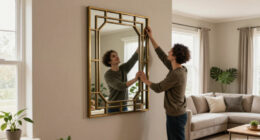
To make a room feel balanced visually, focus on color harmony, furniture arrangement, scale, and how you disperse visual weight. Choose colors that complement each other and place furniture evenly to create stability or appealing asymmetry. Make certain large pieces suit the room’s size, and distribute decorative items thoughtfully to avoid clutter. By paying attention to these elements, you’ll develop a space that feels cohesive and inviting—keep exploring to learn how to master each aspect effectively.

Get furniture and decor delivered free — and shop member deals
- Fast, free delivery on millions of items
- Access to Prime Big Deal Days deals on October 6–7
- Prime Video, Amazon Music and more included
Key Takeaways
- Use complementary or analogous colors to create visual harmony and cohesion.
- Arrange furniture symmetrically or distribute weight evenly for stability.
- Match furniture scale to room size and vary accessory heights for interest.
- Spread visual elements evenly to prevent any one area from dominating.
- Integrate all design elements thoughtfully to achieve a cohesive, inviting space.

Achieving a balanced visual feel in a room is vital for creating a space that’s both inviting and harmonious. When you walk into a room that feels balanced, it immediately resonates with a sense of order and comfort. A key element in reaching this goal is understanding how to use color harmony effectively. Color harmony involves selecting colors that complement each other, creating a cohesive look that’s pleasing to the eye. Instead of clashing, the colors blend seamlessly, making the room appear unified. You might choose a neutral palette with pops of bold color, or opt for analogous colors that sit next to each other on the color wheel. Either way, maintaining a consistent color scheme helps your space feel intentional and well-designed.
Using color harmony creates a cohesive, inviting space that feels balanced and well-designed.
Alongside color harmony, furniture arrangement plays an essential role in establishing visual balance. How you place your furniture can either create symmetry or intentional asymmetry that still feels balanced. For example, positioning two chairs facing each other with a table in between creates a symmetrical focal point, providing a sense of stability. Alternatively, if your room has an asymmetrical layout, you can balance visual weight by distributing larger pieces evenly across the space. Keep in mind that bulky furniture shouldn’t dominate one side while leaving the other side sparse. Instead, balance out heavy pieces with lighter or smaller items elsewhere. This prevents the space from feeling lopsided and guarantees your eye is naturally drawn across the room without feeling overwhelmed.
In addition to color harmony and furniture arrangement, pay attention to scale and proportion. Large furniture should be proportional to the room’s size, and accessories should complement rather than overpower the main pieces. Incorporate varied heights and shapes to add visual interest without creating chaos. For instance, pairing a tall lamp with a low coffee table creates a balanced vertical and horizontal flow that guides your eye smoothly. The placement of artwork, rugs, and accessories also influences how balanced the room feels. Distributing visual weight evenly across different areas prevents any one part from becoming a focal point that throws off the harmony. Moreover, understanding the importance of visual weight distribution can help you create a more cohesive space.
Ultimately, achieving a balanced visual feel hinges on thoughtful choices. When you consider color harmony, furniture arrangement, scale, and distribution of visual weight, you craft a space that feels cohesive and comfortable. The goal isn’t perfection but rather a harmonious blend of elements that invites you to relax and enjoy your environment. With a little attention to these details, your room will radiate balance and style, making it a true reflection of your taste and personality.
As an affiliate, we earn on qualifying purchases.
Frequently Asked Questions
How Do Color Schemes Influence Visual Balance?
Color schemes influence visual balance by creating harmony through hue selection and contrast. When you use color contrast effectively, it draws attention to focal points, balancing the room’s visual weight. Incorporating hue harmony guarantees that colors complement each other, preventing any area from feeling overwhelming or dull. You can achieve a balanced look by carefully choosing contrasting and harmonious colors, guiding the eye smoothly around the space.
What Role Does Lighting Play in Creating Balance?
Lighting is the magic that transforms a room, making it feel perfectly balanced. You control the ambient glow, which softly unifies the space, while natural illumination highlights key areas, drawing your eye smoothly around the room. By layering different light sources—overhead, task, and accent—you create visual harmony. Good lighting emphasizes proportions and balances shadows, ensuring every corner feels inviting and in harmony, making your space truly feel complete.
How Can Furniture Placement Affect Room Harmony?
Furniture placement considerably influences room harmony by emphasizing a focal point and creating a symmetry arrangement. You should position key pieces to draw attention to the focal point, like a fireplace or artwork, ensuring balance on either side. Avoid clutter and uneven spacing, which can disrupt harmony. By thoughtfully arranging furniture around the focal point and maintaining symmetry, you create a cohesive, inviting space that feels visually balanced and comfortable.
Does Room Size Impact Visual Balance Techniques?
Yes, room size impacts visual balance techniques. In smaller spaces, you rely on scale harmony by choosing appropriately sized furniture to enhance spatial perception, making the room feel open rather than cramped. Conversely, larger rooms need contrasting elements or focal points to create balance, preventing emptiness. You’ll find that understanding how scale and spatial perception interplay helps you craft a room that feels both harmonious and inviting, regardless of size.
What Are Common Mistakes That Disrupt Visual Balance?
You disrupt visual balance when you rely too much on artificial symmetry, making a room feel unnatural or overly matched. Clutter management is also essential; clutter can throw off balance by creating visual chaos. Avoid overcrowding surfaces or furniture, and aim for a mix of shapes and sizes. These mistakes can make your space feel unbalanced and less inviting, so be intentional about symmetry and keep clutter in check.
Conclusion
Achieving visual balance in a room isn’t about perfect symmetry; it’s about harmony amid variety. Like a well-composed symphony, your space combines contrasting elements—bold and subtle, large and small—creating a dynamic yet cohesive feel. When you thoughtfully arrange these components, the room feels stable yet lively, inviting both calm and curiosity. It’s this delicate dance between opposites that transforms a mere space into a balanced sanctuary, where every detail complements and elevates the whole.
Fall Picks
fall essentials
As an affiliate, we earn on qualifying purchases.