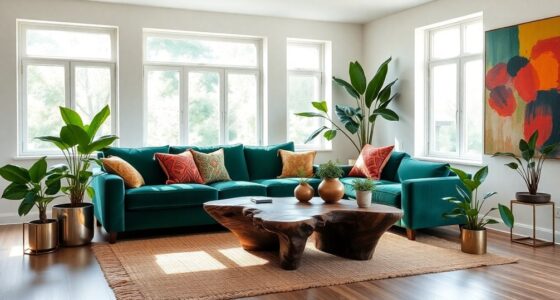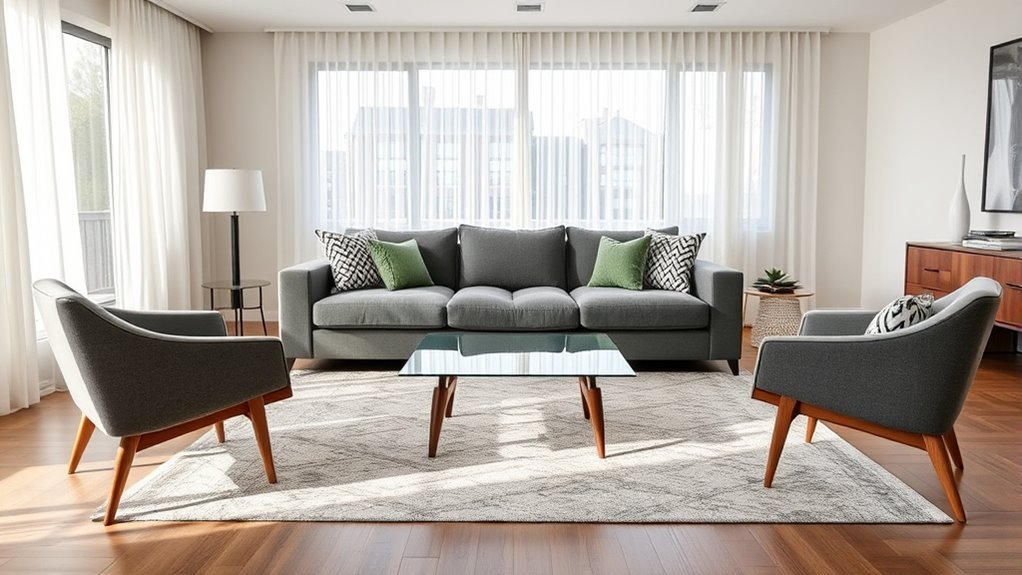

To organize your living room effectively, place your sofa to face the fireplace or main focal point, creating a cozy gathering spot. Arrange chairs in conversational groups around the sofa, leaving 18-24 inches for easy movement. Use rugs and lighting to define zones and improve flow. Keep pathways clear from doorways and windows, and balance furniture for both comfort and style. Continue exploring layout tips to make your space both functional and inviting.
Key Takeaways
- Arrange sofas facing the fireplace or focal point to create a cozy, conversational area.
- Position chairs to complement the sofa, forming inviting conversational groups.
- Maintain 18-24 inch pathways between furniture for easy movement and flow.
- Divide large rooms into zones with rugs or lighting, optimizing space and functionality.
- Balance comfort and practicality by choosing appropriately scaled furniture and thoughtful placement.

Are you wondering how to arrange your living room to make it both functional and inviting? The key lies in thoughtful layout choices that balance practicality with comfort. Start by considering your fireplace placement, as this feature often becomes the natural focal point of the space. Whether your fireplace is on a central wall or tucked into a corner, position your sofa and chairs to maximize its visual appeal. If the fireplace is on a main wall, place your sofa facing it to create a cozy gathering area. This arrangement not only highlights the fireplace but also encourages conversation and warmth. If the fireplace is in a less prominent spot, surround it with comfortable chairs and accent pieces to draw attention and create a balanced look.
Lighting strategies are equally crucial when designing your living room layout. Good lighting can transform the ambiance and make the space more inviting. Use a combination of natural light, overhead fixtures, and task lighting to achieve this. Position your sofa and seating to take advantage of windows, letting in sunlight during the day. In the evening, add table lamps or floor lamps near seating areas to create warm, inviting pools of light. Consider placing a statement chandelier or pendant light centered over your main seating area, which provides overhead illumination and acts as a visual anchor. Layering lighting not only enhances functionality but also adds depth and warmth to your space. Additionally, incorporating appropriate lighting fixtures can enhance safety and highlight architectural features.
Next, think about the flow of movement within your living room. You want a layout that allows easy navigation without feeling cramped. Keep pathways clear by spacing furniture appropriately—ideally, leave at least 18 to 24 inches between pieces. This ensures you can move freely while maintaining a cozy, intimate atmosphere. Arrange your sofa and chairs in a way that encourages conversation, such as in a U-shape or around a central coffee table, but avoid blocking doorways or windows. The flow should feel natural, inviting guests to circulate effortlessly through the room.
Finally, consider the overall size of your living room when arranging furniture. For smaller spaces, opt for a compact sectional or a sofa with a couple of chairs to maximize seating without overcrowding. In larger rooms, you can create multiple zones, like a main seating area and a reading nook, divided by rugs or lighting. Always keep in mind that thoughtful fireplace placement, combined with strategic lighting and mindful furniture arrangement, will make your living room both functional and welcoming. By balancing these elements, you’ll craft a space that’s perfect for relaxing, entertaining, and making lasting memories.

CTSC 8500W Garage Heater Electric, 240v Hardwired Fan-Forced Electric Garage Heater with Digital Thermostat, Remote Control and Timer, ECO Function, Ideal for Workshop, ETL Listed Garage Heater
Quick Troubleshooting: Through a lot of market research, we found that the most frequent failure of this kind...
As an affiliate, we earn on qualifying purchases.
Frequently Asked Questions
How Do I Choose the Right Size Sofa for My Living Room?
To choose the right size sofa, measure your space carefully, leaving enough room for movement and other furniture. Consider your sofa maintenance needs; a larger sofa may require more upkeep, especially with furniture upholstery. Opt for a size that balances comfort and proportion to your room. Remember, a well-sized sofa enhances flow and makes your living room inviting without overwhelming the space.
What Are the Best Chair Styles for Small Living Rooms?
Did you know that 65% of small living rooms benefit from versatile furniture? For your space, consider accent chairs that add style without crowding. Modular seating is also a smart choice, allowing you to customize and reconfigure as needed. These styles maximize seating while keeping the room open and inviting. With the right selection, you’ll create a cozy, functional area that feels spacious and stylish.
How Can I Create a Natural Flow Between Furniture Pieces?
To create a natural flow, you should arrange your furniture to encourage easy movement and conversation. Use decorating styles that complement each other, ensuring harmony. Incorporate lighting techniques like layered lighting and accent lights to highlight key areas and guide the eye smoothly through the space. Keep pathways clear, and position pieces at appropriate distances, so your living room feels inviting and well-connected without feeling cramped.
What Are Some Space-Saving Layout Ideas for Limited Rooms?
To save space in limited rooms, opt for multi-functional furniture like a sofa bed or storage ottomans, which serve dual purposes. Use wall-mounted storage to free up floor space and keep essentials organized. Arrange your furniture to maximize open areas, such as placing pieces against walls or in corners. These ideas help create a functional, spacious feel without sacrificing comfort or style.
How Do I Incorporate Multiple Seating Areas Without Clutter?
You can incorporate multiple seating areas by creating distinct multi zone zones around focal points like a fireplace or a large window. Use rugs and furniture placement to define each zone without clutter. Opt for versatile pieces, such as ottomans and modular sofas, that can be rearranged easily. This approach keeps your space organized and inviting, while allowing conversation and relaxation in different areas of your living room.

Comfort Zone 1500W Ceiling Mounted Dual Quartz Radiant Heater – Infrared Workshop Heater with 90° Adjustable Tilt, Built-in Halogen Light & Pull String Control – Overheat Protection, Black
INSTANT INFRARED RADIANT HEAT: Utilizing dual high-powered quartz tubes, this heater provides sun-like warmth that directly heats people...
As an affiliate, we earn on qualifying purchases.
Conclusion
Designing your living room is like crafting a cozy oasis; the right layout makes everything flow effortlessly. By thoughtfully arranging your sofa, chairs, and pathways, you create a space that’s both functional and inviting. Remember, a well-planned layout is like a good dance partner—guiding you smoothly through the room’s rhythm. So, take your time, experiment, and enjoy the process of making your living room truly feel like home.

Comfort Zone 5000W Ceiling Mounted Garage Heater – 240V Electric Shop Heater with 3 Heat Settings, Overheat Protection, Indoor Use, ETL Listed, Grey
EFFICIENT CEILING MOUNT: With its ceiling-mount design and hard-wired installation, this fan-forced heater is perfect for spaces like...
As an affiliate, we earn on qualifying purchases.

Shinic 2 Packs Electric Garage Heaters, 1500W/750W Ceiling Mounted Heater Radiant Heaters with Halogen Light, 90 Degree Rotation, 5 Mode Settings, Space Heater for Garage, Shop, Large Room and Patio
【Packing List】2 x Electric Garage Heater,2 x Adjustable Bracket and Accessories, 1 x User's Manual
As an affiliate, we earn on qualifying purchases.