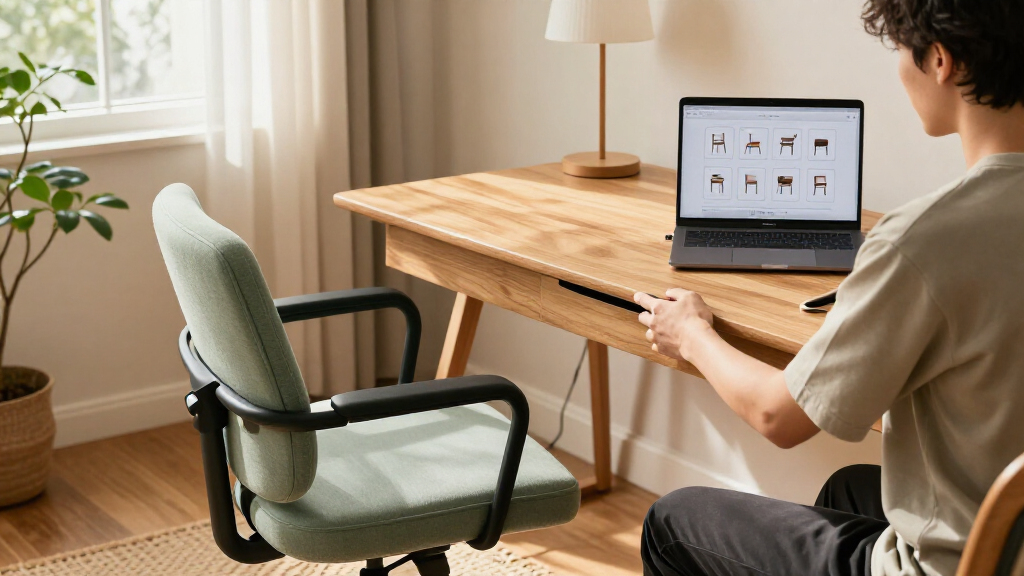

This checklist is for anyone setting up or refreshing a home office, whether you work at a desk all day or need a comfortable place for focused tasks. Use it to consider the furniture and accessories that shape comfort and organization before you buy.

Get furniture and decor delivered free with Prime
- Fast, free delivery on millions of items
- Prime Video, Amazon Music and more included
- Member-only deals all year
The sections follow common workspace needs: seating, desk height, monitor positioning, task lighting, file storage, and foot support. Each one highlights the role that item plays, practical details to check, and a specific pick where one was provided. The monitor arm section offers guidance without a product recommendation.
Use the checklist to compare each item with your room, work habits, and existing equipment. Check dimensions and compatibility against your setup, and think through how you will use each piece day to day. Prioritize the changes that address your biggest workspace needs, then revisit the remaining sections as your office takes shape.
Ergonomic Office Chair
A chair affects how your workspace feels throughout the day, so start by considering how long you sit and what support you need. The ELABEST X100 Ergonomic Mesh Office Chair with Footrest is the listed pick. Before choosing it, check the chair’s dimensions and adjustment details against your body and desk, and confirm that its footprint works in your room.
A common buying mistake is focusing on a chair’s feature list without checking whether its adjustments suit the person using it. Compare seat height with your desk, and make sure you can sit with your feet supported and your arms comfortably positioned for keyboard use. Also check the space needed to move the chair and recline, if that is part of how you plan to use it. A chair that fits the room but not your desk setup can make everyday work less comfortable.
Consider the included footrest in relation to your preferred sitting position and the separate footrest section below. Review product dimensions and assembly requirements before ordering, and measure doorways or tight paths if the chair will need to pass through them. Choose based on adjustability and fit for your workspace, not on a long list of features alone.
What to look for:
- Check seat-height range against your desk.
- Compare chair dimensions with available floor space.
- Review adjustments for seat, back, and arm positioning.
- Confirm clearance for reclining or moving the chair.
- Check whether the included footrest suits your setup.
ELABEST X100 Ergonomic Mesh Office Chair with Footrest

The ELABEST X100 is a breathable mesh office chair with adjustable lumbar support, a headrest, flip-up armrests, and an extendable footrest. It reclines and supports users up to 300 pounds, with tool-free assembly and a 5-year satisfaction warranty.
Pros:
- Adjustable lumbar support, headrest, and armrests
- Extendable footrest and reclining mechanism
- Breathable mesh upholstery
- Supports up to 300 pounds
Cons:
- Multiple adjustments may take time to configure
- Designed for indoor use
Best for: People seeking an ergonomic mesh chair with a footrest.
Not ideal for: Workspaces with limited room for chair movement.
Bottom line: Measure your desk and available floor space, then compare them with the chair’s specifications.
Adjustable Standing Desk
A desk sets the height and usable surface for your main work area. The listed pick is the FLEXISPOT 4-Leg Standing Desk, 63″x28″, Electric Height Adjustable, Wh. Its product name identifies a 63-by-28-inch surface and electric height adjustment; check the full listing for any details not included in the supplied name.
A common mistake is buying a desk based on its surface area without mapping out the equipment that needs to fit there. Measure your monitor, keyboard, mouse, and any other everyday items, then leave room for comfortable placement. Check the desk’s height range against your seated and standing positions, and verify that your chair can tuck in without hitting supports or nearby furniture. Confirm the assembled footprint fits the room and that the route into the workspace can accommodate the desk.
Think about how the desk will work with a monitor arm, if you plan to use one. Check mounting compatibility and the available edge or underside space against the arm’s requirements. Also consider where cables will run as the desk changes height. Reviewing dimensions and compatibility before purchase can help you avoid a surface that is too small or a setup that conflicts with other equipment.
What to look for:
- Confirm the 63-by-28-inch surface fits your room.
- Compare the height range with your seated and standing positions.
- Check that desk supports do not interfere with your chair.
- Verify monitor-arm mounting compatibility if needed.
- Plan cable routing for both sitting and standing positions.
FLEXISPOT 4-Leg Standing Desk, 63"x28", Electric Height Adjustable, White

This electric standing desk features a stable four-leg frame with a spacious 63"x28" surface, adjustable height from 28.7" to 47.2", and a memory control panel for easy customization. Its modern design enhances any workspace, supporting ergonomic working positions and durability with a 5-year warranty.
Pros:
- Stable four-leg design for enhanced durability
- Adjustable height with memory function for convenience
- Spacious desktop suitable for various work setups
- Modern minimalist aesthetic
Cons:
- Not compatible with casters or under-desk drawers
- Control panel requires pressing all height keys during use
Best for: People who want an electric height-adjustable desk.
Not ideal for: Rooms that cannot accommodate its listed surface dimensions.
Bottom line: Check the full height range and assembled footprint against your room and work setup.
Monitor Arm
A monitor arm can help position a screen in relation to your chair, desk, and viewing habits. Since no product pick is specified for this slot, use the checklist to compare options that suit your display and work surface. Start with the monitor’s weight and mounting pattern, then check that the arm supports both. Compatibility comes first; an arm that cannot attach securely or support the screen is not a workable choice.
A frequent mistake is assuming every monitor and desk can use the same mount. Check whether the display has a compatible mounting interface, and review the arm’s stated limits for screen size and weight. For the desk, inspect its edge thickness and construction where the clamp or mounting hardware would sit. If the desk has a cable tray, crossbar, or other structure beneath it, confirm that the arm can be installed without interference.
Consider the movement you need: the screen may need to move closer, farther away, or to a different height as you change posture. Check the arm’s range and the space required for that movement, including clearance from a wall and nearby equipment. Plan cable length and routing too, so adjustment does not tug on connections. Use the product specifications for both monitor and desk, and measure before ordering.
What to look for:
- Match the arm’s mounting pattern to your monitor.
- Check the screen’s weight and size against the arm’s stated limits.
- Measure desk-edge thickness and confirm mounting compatibility.
- Check clearance beneath and behind the desk.
- Review movement range and cable routing needs.
Desk Lamp
Task lighting helps you arrange a work area around the activities you do there. The listed pick is the OttLite LED Desk Lamp with Color Changing Base and USB Port, White. Its name calls out an LED lamp, a color-changing base, and a USB port; consult the product listing for the lamp’s dimensions and other specifications.
A common mistake is choosing a lamp without checking how much desk space it occupies or where its light will fall. Measure the intended spot and consider whether the lamp’s base or arm would crowd your keyboard, monitor, or writing area. Check the lamp’s height and reach against your desk layout, and think about whether it can be positioned without casting unwanted shadows on the surface. If you already use a monitor arm or other desk-mounted accessories, map their positions together.
Review the power connection and the placement of outlets before settling on a location. The USB port may be useful in your setup, but check the listing for its specific capabilities rather than assuming what it can power or charge. Confirm the finish works with your workspace if appearance matters to you. Prioritize placement and reach, then check the listed features against how you plan to use the lamp.
What to look for:
- Measure the lamp’s footprint against available desk space.
- Check height and reach for your intended placement.
- Review the power connection and nearby outlet location.
- Confirm USB port details in the product listing.
- Check that the lamp will not obstruct other desk equipment.
OttLite LED Desk Lamp with Color Changing Base and USB Port, White

Modern white LED desk lamp featuring OttLite’s high-contrast, low-glare natural daylight illumination. Offers 3 color temperature modes and 3 brightness settings, with a base that glows in your choice of color or cycles through the spectrum.
Pros:
- High-contrast, low-glare OttLite illumination reduces eye strain
- Adjustable color temperature and brightness settings
- Flexible neck with wide height adjustment range
- Built-in USB port and fun color-changing base
Cons:
- Not water resistant
- Relatively low wattage may not suit users wanting very bright output
Best for: People who want an LED desk lamp with a color-changing base.
Not ideal for: Desks with no suitable space for its footprint.
Bottom line: Check the lamp’s dimensions, reach, and connection details before choosing a spot.
Filing Cabinet
File storage can give paperwork a designated place and help keep a work surface clear. The listed pick is the FireKing Turtle Vertical 4 Drawer Fire Rated File Cabinet, Platinum. The name identifies a vertical four-drawer cabinet and describes it as fire rated; check the manufacturer’s listing for its dimensions, capacity, and other specifications.
A common buying mistake is assuming a cabinet will fit simply because its footprint seems manageable. Measure the available floor area and account for drawer clearance, nearby furniture, and the path needed to open drawers. Check the cabinet’s height against windows, shelves, and desk surfaces. Also confirm that the drawer configuration and stated file compatibility match the documents you plan to store; the supplied product name does not specify which file sizes it accepts.
Think about where the cabinet will sit in relation to your desk and how often you need to reach its contents. Review the product information for handling, placement, and any care guidance that matters for your room. The fire-rated description is part of the product name, but use the listing to understand the details and limits of that feature. Choose a location that supports easy access and usable clearance, and verify the cabinet’s measurements before ordering.
What to look for:
- Check the cabinet’s full dimensions against the available floor space.
- Allow room to open each drawer fully.
- Confirm drawer compatibility with the file sizes you use.
- Review handling and placement guidance in the listing.
- Check the details of the fire-rated feature.
FireKing Turtle Vertical 4 Drawer Fire Rated File Cabinet, Platinum

This fire-rated filing cabinet provides one-hour fire protection, keeping documents and valuables safe in extreme conditions. Made of high-quality steel, it features four easy-slide drawers suitable for legal and letter-sized files, with a secure lock system and a sleek, scratch-resistant finish, ideal for small offices or home use.
Pros:
- Provides one-hour fire protection for documents
- Secure lock system for anti-theft security
- Fits both legal and letter-sized files
- Sleek, scratch-resistant design
Cons:
- Heavy weight (435 pounds) may be difficult to move
- No price information available
- Limited to fire and impact resistance, no mention of water resistance
Best for: People who need vertical file storage with four drawers.
Not ideal for: Small offices without room for drawer clearance.
Bottom line: Verify the cabinet’s measurements, file compatibility, and placement needs before ordering.
Under-Desk Footrest
A footrest can provide an additional way to position your feet while seated. The listed pick is the Step-to-Adjust Foot Rest – Infinite Height Adjustment from 2.7″ to 13.. The supplied name gives an adjustment range beginning at 2.7 inches and ending at 13, but its final measurement is incomplete; check the product listing to confirm the full range and dimensions.
A common mistake is choosing a footrest without checking whether it fits beneath the desk or works with the chair’s seat height. Measure the clearance from the floor to the underside of the desk, and account for any supports or drawers that could limit placement. Compare the footrest’s height range with your seated position, and check its width and depth against the space for your feet. Your knees and feet should have room to move without the footrest blocking a comfortable position.
Consider how often you expect to adjust it and whether its adjustment method suits your routine. Check the product listing for its footprint, surface, and any other relevant design details. If your chair already includes a footrest, compare how each option fits your sitting setup before adding another item. Make the choice using measured clearance and seated fit, and confirm the incomplete specification before purchase.
What to look for:
- Confirm the full adjustment range in the product listing.
- Measure desk clearance, including supports and drawers.
- Compare footrest width and depth with available floor space.
- Check that its height suits your seated chair position.
- Review adjustment details and surface specifications.
Step-to-Adjust Foot Rest – Infinite Height Adjustment from 2.7" to 13.1"
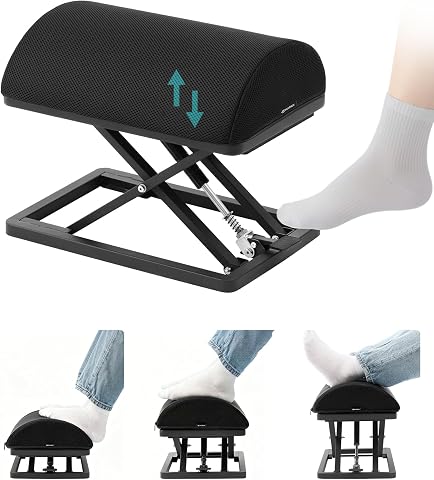
This adjustable foot rest features a patent-pending design that allows instant height adjustment with a simple tap, providing customized ergonomic support. Made from durable carbon steel with a comfortable foam cushion, it enhances comfort during work, gaming, or studying.
Pros:
- Instant, infinite height adjustment with a tap for personalized comfort
- Durable construction tested for over 10 years of use
- Ergonomic foam cushion supports feet and improves circulation
- Non-slip pads ensure stability during use
Cons:
- Warning about potential finger entrapment during operation
- Heavier weight may be less portable
Best for: People seeking an under-desk footrest with adjustable height.
Not ideal for: Setups with little floor clearance beneath the desk.
Bottom line: Confirm the full height range and measure under-desk clearance before choosing.
Build your office in a practical order: first address the chair and desk fit, then position your monitor and lighting, and add storage or foot support according to your daily needs. Check dimensions and compatibility at each step so new pieces work with the space and equipment you already have.
You do not need to solve every workspace detail at once. Start with the items that affect your routine most, use the checklist to guide each decision, and adjust the layout as you learn what works for you. A few careful measurements can help make your home office more comfortable and organized.
Halloween Picks
halloween
As an affiliate, we earn on qualifying purchases.