Finding the best whole house surge protector can be confusing with so many options available, each offering different features and power capacities. The top pick is the FHSPD36S for its reliable 36,000-amp protection suitable for most homes. The WiFi Whole House Surge Protector stands out for its real-time monitoring and smart alerts, making it ideal for tech-savvy homeowners. However, higher protection ratings often come with increased costs and installation complexity. Continue reading to see how these options compare and which one fits your specific needs best.
Complete the kit


Key Takeaways
- Protection capacity (measured in amps) varies significantly; higher amps generally mean better protection but at a higher cost.
- Additional features like WiFi monitoring add value for tech-oriented users but may increase complexity and price.
- Type 1 vs. Type 2 surge protection impacts installation ease; Type 1 is usually installed at the main panel, Type 2 is added downstream.
- Build quality and weather resistance are critical for outdoor units, affecting durability and lifespan.
- Price ranges reflect protection capacity, features, and brand reputation; balancing cost and needs is key for the best value.




| whole house surge protector | Voltage |
|---|---|
| FHSPD36S Whole House Surge Pro | 120/240V |
| Bad Wolf SP240V200KA Whole Hou | 120/240V split-phase |
| Siemens Boltshield FSPD140 Lev | 120/240V |
| Eaton CHSPT2SURGE SPD Type 2 W | 120/240 Volts |
| Eaton Surge Protection Device | 120/240V |
| WiFi Whole House Surge Protect | 120/240V |
| FHSPD108S Whole House Surge Pr | 120/240V |
| Intermatic IG2240-IMSK Smart G | 120/240 VAC |
| Square D by Schneider Electric | 120/240V |
| Square D HEPD80 Universal Whol | — |
| FHSPD140 Whole House Surge Pro | 120/240V |
More Details on Our Top Picks
FHSPD36S Whole House Surge Protector for 36,000 Amps, Indoor/Outdoor Use
The FHSPD36S stands out as the best overall choice due to its impressive 36,000 Amp surge capacity, making it suitable for most residential needs. Compared with the Siemens Boltshield FSPD140, it offers slightly less surge capacity but excels in compactness and ease of installation for homeowners comfortable with professional setup. Its compatibility with all brands of load centers and effective LED alerts add to its reliability. However, it requires professional installation and correct grounding, which could be a hurdle for DIY enthusiasts. This model is ideal for homeowners seeking a balanced mix of power and ease of integration without going into the premium price range.
Pros:- High surge capacity of 36,000 Amps for comprehensive protection
- Compact, space-saving design fits easily in various load centers
- Compatible with all brands of load centers and circuit breakers
- Effective LED status indicators for monitoring
Cons:- Requires professional installation and grounding
- Potential startup issues if not installed correctly
Best for: Homeowners who want strong, reliable whole house protection with flexibility for indoor or outdoor installation
Not ideal for: DIYers with limited electrical experience or those needing a plug-and-play solution, due to installation complexity
- Capacity:36,000 Amps
- Voltage:120/240V
- Frequency:60Hz
- Application:Indoor/Outdoor
Our verdict“This surge protector is best suited for homeowners who need robust, versatile protection and are comfortable with professional installation.”
Bad Wolf SP240V200KA Whole House Surge Protector, 200kA, Type 1 SPD, 120/240V Split-Phase, ETL Listed, NEMA 4X IP67
The Bad Wolf SP240V200KA offers exceptional 200kA surge protection, making it ideal for areas prone to lightning strikes or power surges. Unlike the FHSPD36S, it is a Type 1 device designed for direct connection at the service entrance, providing primary defense. Its rugged NEMA 4X/IP67 enclosure ensures durability outdoors and in harsh environments. While its hardwired setup is more complex and may require professional help, this model is perfect for those needing maximum surge capacity and outdoor robustness. It’s less suited for users who prefer plug-in solutions or have simpler electrical setups. Overall, this pick provides peace of mind against severe surges at a premium price point.
Pros:- Robust 200kA surge protection for entire house
- Rugged NEMA 4X/IP67 enclosure for outdoor and harsh environments
- Easy-to-read LED status indicators
- Suitable for indoor and outdoor installation
Cons:- Requires hardwired professional installation
- Limited to split-phase 120/240V systems
- No remote monitoring features
Best for: Homeowners in lightning-prone regions or with large electrical loads needing maximum surge capacity
Not ideal for: DIYers seeking an easy, plug-and-play installation or those with basic residential systems
- Protection Capacity:200kA
- Voltage:120/240V split-phase
- Type:Type 1 SPD
- Enclosure Rating:NEMA 4X, IP67
Our verdict“This surge protector is best for those needing maximum, durable, outdoor-capable surge protection, accepting installation complexity.”
Siemens Boltshield FSPD140 Level 2 Whole House Surge Protection Device 140,000 Amps, 120/240V
The Siemens Boltshield FSPD140 offers solid 140,000 Amps of surge current protection, making it a reliable choice for most residential applications. Its standout feature is the combination of visual and audible alerts that notify you when it needs replacement, unlike models like the Eaton CHSPT2SURGE that lack such features. This device is suitable for outdoor installation with its Type 4 enclosure, providing versatile placement options. However, the need for professional installation and the higher cost compared to simpler models make it less appealing for budget-conscious homeowners or those comfortable with DIY wiring. It’s best suited for users who want added peace of mind through maintenance alerts and durable outdoor protection.
Pros:- High surge capacity of 140,000 Amps
- Visual and audible alerts for maintenance needs
- Outdoor-rated Type 4 enclosure for versatile installation
- Reliable protection for entire house
Cons:- Requires professional installation
- Higher price point compared to basic models
- Limited surge modes compared to multi-mode protectors
Best for: Homeowners who want reliable surge protection coupled with clear maintenance alerts and outdoor installation
Not ideal for: DIYers seeking a simple, budget-friendly surge protector or those with minimal surge risk
- Surge Current Rating:140,000 Amps
- Voltage:120/240V
- Enclosure Rating:Type 4 outdoor
- Protection Modes:Multiple
Our verdict“This device is ideal for users seeking detailed alert features and durable outdoor protection with high surge capacity.”
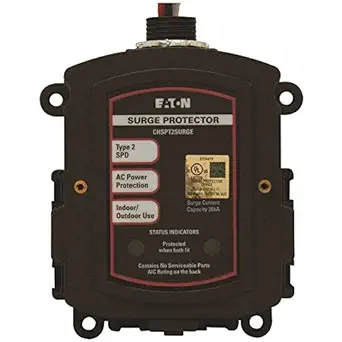
Eaton CHSPT2SURGE SPD Type 2 Whole Home Surge Protector, NEMA 4, Single Phase, 120/240 Volts
The Eaton CHSPT2SURGE offers a convenient, quick-connect design that simplifies installation, making it attractive for homeowners who want effective protection without complex wiring. Its NEMA 4 rating ensures durability in various environments, and it provides reliable surge suppression for standard residential systems. Unlike the Bad Wolf or Siemens models, it emphasizes ease of setup, though it offers less detailed surge capacity information, which might concern those wanting maximum specs. This makes it less suitable for extreme surge-prone areas but perfect for typical homes. It’s a good choice for those prioritizing installation simplicity and compatibility with a range of load centers.
Pros:- Universal compatibility with various load centers
- Quick connect design for fast installation
- Durable NEMA 4 enclosure
- Reliable surge protection for typical residential use
Cons:- Limited information on maximum surge capacity
- Requires professional installation for safety
- Less suited for high lightning areas
Best for: Homeowners looking for straightforward, reliable surge protection with easy installation
Not ideal for: Users needing high surge capacity or outdoor ruggedness in severe weather zones
- Type:Type 2 Surge Protector
- NEMA Rating:NEMA 4
- Phase:Single Phase
- Voltage:120/240 Volts
Our verdict“This surge protector is ideal for homeowners wanting a hassle-free, compatible solution for standard residential surge protection.”
Eaton Surge Protection Device, 1 Phase, 120/240V, 2 Poles, 2 Wires
The Eaton CHSPT2ULTRA provides a straightforward surge protection solution for 1-phase systems, like smaller homes or specific load centers. Compared with the more feature-rich models like the Siemens Boltshield, it emphasizes simplicity and ease of installation, making it suitable for budget-conscious or less complicated setups. Its high-quality construction ensures durability, but the lack of detailed surge capacity data makes it less ideal for extremely surge-prone environments. This device is best suited for users who want dependable, no-fuss protection on a budget and do not need outdoor ratings or advanced alert features.
Pros:- Universal compatibility with various load centers
- Easy to install and operate
- High-quality build ensures durability
- Suitable for basic residential surge protection
Cons:- Limited to 1-phase systems
- No detailed surge capacity specifications
- Lacks advanced alert or monitoring features
Best for: Homeowners with straightforward 1-phase systems seeking reliable, easy-to-install surge protection
Not ideal for: Homes with outdoor exposure or high lightning risk needing advanced features or higher surge capacity
- Model Number:CHSPT2ULTRA
- Voltage:120/240V
- Phases:1
- Poles:2
Our verdict“This surge protector makes sense for users seeking a dependable, simple solution for standard residential systems without complex requirements.”
WiFi Whole House Surge Protector – 100 KA/2450 Joules, Real-Time WiFi Monitoring, Instant Surge Alerts & Historical Tracking, Type 2 SPD for 120/240V Panels
This surge protector stands out for its integration of WiFi monitoring and instant alerts, making it ideal for homeowners who want real-time control over their electrical safety. Compared with the more straightforward FHSPD108S, this model offers extensive tracking features and app-based alerts but requires a stable WiFi connection and setup, which could incur extra costs. Its high surge energy capacity of 2450 Joules and 100KA per phase ensure robust protection, especially for sensitive electronics and smart devices. However, its single outlet design limits coverage, and reliance on WiFi means potential vulnerabilities if your network is unstable. Overall, this pick suits tech-savvy users seeking peace of mind through remote monitoring, but it may be overkill for those preferring simple, wired solutions.Pros:- Provides detailed real-time WiFi monitoring and surge alerts
- High surge capacity with 2450 Joules and 100KA per phase
- Includes surge event logging and historical data
- Multiple protection modes for versatile wiring
Cons:- Requires stable WiFi connection and app setup
- Potential extra costs for alert notifications
- Limited to one outlet, restricting coverage
Best for: Homeowners with smart devices and a reliable WiFi network who want real-time surge alerts.
Not ideal for: Users with limited WiFi or minimal electronics, as the setup complexity outweighs the benefits.
- Number of Outlets:1
- Voltage:120/240V
- WiFi Monitoring:Yes
- Surge Protection Energy:2450 Joules
- Surge Protection Current:100KA per phase
- Item Dimensions:6.1″ L x 3.54″ W
Our verdict“This is ideal for tech-savvy users wanting detailed, remote surge protection management, but not for those seeking a simple, plug-and-play solution.”
FHSPD108S Whole House Surge Protector for 108,000 Amps, Indoor/Outdoor Use
The FHSPD108S makes the most sense for homeowners seeking a straightforward, high-capacity surge protector that can handle thunderstorms and power surges without fuss. Its 108,000 Amp capacity places it ahead of smaller models like the Square D HEPD50, offering a more resilient barrier against voltage spikes. Its compact design allows for flexible installation in tight spaces, and its commercial-grade enclosure ensures durability outdoors. The main tradeoff is that professional installation is recommended, and improper grounding can reduce its effectiveness. This model suits those who prioritize raw capacity and durability over smart features or monitoring, making it a reliable choice for critical systems.Pros:- High surge capacity of 108,000 Amps for robust protection
- Compact, space-saving design
- Suitable for indoor and outdoor use with a durable enclosure
- Compatible with various load centers and breakers
Cons:- Requires professional installation and proper grounding
- Potential startup issues if misused or improperly grounded
Best for: Homeowners needing high-capacity, durable surge protection suitable for outdoor installation.
Not ideal for: Users looking for smart features or easy DIY installation, as professional setup is recommended.
- Capacity:108,000 Amps
- Voltage:120/240V
- Frequency:60Hz
- Enclosure:Commercial-grade
Our verdict“This surge protector offers high capacity and outdoor suitability, ideal for those who want a rugged, no-nonsense solution.”
Intermatic IG2240-IMSK Smart Guard Whole-House Surge Protector, 120/240 VAC
The Intermatic IG2240-IMSK earns its spot by offering a durable, indoor-rated solution with replaceable IMODULES, making maintenance straightforward for homeowners comfortable with wiring. Unlike the more basic Square D HEPD50, this model adds a layer of convenience with its replaceable modules, reducing the need for costly replacements or rewiring. Its 10-year warranty and $50,000 equipment coverage contribute to peace of mind, though the indoor metal enclosure limits placement options and installation complexity can be a barrier for DIYers. This pick is best for those who want a reliable, long-term solution with minimal fuss once installed.Pros:- Replaceable IMODULES simplify ongoing maintenance
- Durable, tamper-proof design with disconnect switch
- 10-year warranty and $50,000 equipment coverage
- Provides comprehensive protection for entire home
Cons:- Indoor metal enclosure limits placement options
- Complex installation requiring wiring to main panel
Best for: Homeowners comfortable with wiring who seek a durable, maintainable surge protector with long warranty coverage.
Not ideal for: DIY novices or those needing outdoor or highly accessible units, due to installation complexity and enclosure limitations.
- Voltage:120/240 VAC
- Enclosure:Type 1
- Warranty:10 years
- Connected Equipment Warranty:$50,000
Our verdict“This model suits experienced homeowners seeking durable, maintainable surge protection with long-term warranty coverage.”
Square D by Schneider Electric HEPD50 Universal Whole House Surge Protection Device, 50kA, Black
The HEPD50 offers a dependable solution for basic surge protection, with a 50,000 amp surge current rating that suffices for most residential needs. It stands out for its NEMA 4X rating, making it suitable for indoor or outdoor installation, and the LED indicator ensures correct setup. Compared with the more powerful Square D HEPD80, it provides slightly less surge capacity but at a lower cost, making it appealing for budget-conscious buyers. Its main drawback is the need for professional installation, and its 3-year warranty is shorter than higher-end models. For homes with moderate surge risk and less focus on capacity, this device offers a solid balance of performance and affordability.Pros:- Provides reliable surge protection up to 50,000 amps
- Suitable for indoor and outdoor use with NEMA 4X rating
- Easy to monitor with built-in LED indicator
- Affordable option for basic protection needs
Cons:- Requires professional installation
- Limited to 3-year warranty, shorter than premium options
Best for: Budget-conscious homeowners needing reliable, basic whole house surge protection.
Not ideal for: Homes with high surge risk or sensitive electronics requiring higher capacity, where the HEPD80 would be more appropriate.
- Surge Current Rating:50,000 amps
- Rating:NEMA 4X
- Voltage:120/240V
- Warranty:3 years
Our verdict“This surge protector fits budget-minded homeowners seeking dependable, straightforward whole house protection for moderate surge environments.”
Square D HEPD80 Universal Whole House Surge Protection Device, 80kA
The HEPD80 offers a significant step up in surge capacity with 80,000 amps, making it suitable for homes with higher surge risk or more sensitive electronics. While it shares many features with the HEPD50, such as NEMA 4X rating and LED indicators, its increased amperage rating makes it better suited for environments prone to larger voltage spikes. The main tradeoff is the higher cost and the necessity of professional installation. Compared to the HEPD50, it provides extra peace of mind for demanding situations but might be more than needed for average homes, making it best for those with outdoor or high-risk electrical setups.Pros:- Provides reliable protection with 80,000 amps surge capacity
- Suitable for outdoor and indoor installation with NEMA 4X rating
- Includes an LED indicator for proper operation
- Backed by a 5-year manufacturer’s warranty
Cons:- Requires professional installation
- Higher cost than lower-capacity units
Best for: Homes in areas with frequent thunderstorms or with sensitive electronics needing extra surge capacity.
Not ideal for: Budget-conscious homeowners or those with minimal surge exposure, as the added capacity may be overkill.
- Surge Current Rating:80,000 amp
- Wires:3-Wire
- Rating:NEMA 4X
- Warranty:5 years
Our verdict“This device is well-suited for high-risk environments or homes with sensitive electronics, offering increased capacity for peace of mind.”
FHSPD140 Whole House Surge Protector – 140,000 Amps, Indoor/Outdoor, 120/240V
The FHSPD140 stands out for its impressive surge capacity of 140,000 amps, making it ideal for homes in storm-prone areas or with high electrical demands. Compared to models like the Eaton CHSPT2SURGE, which offers a more streamlined, Type 2 protection suited for standard use, the FHSPD140 provides a robust, all-in-one solution that can handle larger voltage spikes. Its suitability for both indoor and outdoor installation provides flexibility, but this comes with the need for professional installation to ensure proper grounding—an essential step that can add to the upfront cost. While the LED indicators help monitor status, potential startup issues if not grounded properly could pose risks. This pick makes the most sense for homeowners seeking maximum surge capacity and outdoor durability, especially in areas vulnerable to frequent electrical storms.Pros:- High surge capacity of 140,000 amps for reliable, heavy-duty protection
- Indoor/outdoor versatility allows installation in varied environments
- Compatible with all brands of load centers and circuit breakers
Cons:- Requires professional installation for proper grounding, adding cost and complexity
- Potential startup issues if not grounded correctly, risking device malfunction
Best for: Homeowners living in storm-prone regions or with high electrical loads needing outdoor-compatible, heavy-duty surge protection
Not ideal for: Average households with standard surge protection needs who prefer DIY installation and simpler devices
- Surge Capacity:140,000 amps
- Voltage:120/240V
- Frequency:60Hz
- Use:Indoor/Outdoor
Our verdict“This surge protector is best suited for homes in harsh weather zones or with high electrical demands that require outdoor durability and maximum capacity.”

How We Picked
I selected these products based on a combination of surge capacity, build quality, ease of installation, and additional features like smart monitoring. I prioritized models with high amp ratings suitable for various home sizes and configurations, ensuring reliable protection. Durability and weather resistance were also key factors, especially for outdoor units. The ranking emphasizes value for different budgets, balancing performance with cost, and considers customer reviews and industry standards to determine real-world effectiveness.Factors to Consider When Choosing Best Whole House Surge Protector
Choosing the best whole house surge protector involves considering several factors beyond just protection ratings. Understanding your home’s electrical setup and future needs can help you avoid overspending or installing an inadequate system. Here are key considerations that can influence your decision and ensure you get the right level of protection for your investment.Protection Capacity (Amps)
The main factor is the surge capacity measured in amps. Higher amps generally mean the device can handle larger surges, which is vital for homes with complex electrical systems or sensitive electronics. However, overspending on a very high-capacity unit might be unnecessary for smaller homes. Assess your home’s electrical load and consult an electrician if unsure, to match the surge protector to your specific needs without paying for unused capacity.
Type of Surge Protection
Type 1 devices are installed at the main service panel, offering primary protection from external surges like lightning strikes. Type 2 units are placed downstream, protecting individual circuits or appliances. Combining both types provides comprehensive coverage, but installation complexity and cost increase accordingly. Understanding where your home is most vulnerable helps you decide whether a single type or a combination makes sense.
Indoor vs. Outdoor Use
Outdoor surge protectors must withstand weather elements like rain, snow, and UV exposure. Look for units with weatherproof enclosures rated NEMA 4X or similar for outdoor installation. Indoor models are more affordable but lack durability against environmental stresses. Choosing the right enclosure extends the lifespan of your device and ensures consistent protection over time.
Smart Features and Monitoring
Some surge protectors include WiFi connectivity, real-time alerts, and historical data tracking. These features are especially useful for tech-savvy homeowners who want to monitor their system remotely or get early warnings of surges. However, they typically come at a higher price and may require ongoing maintenance or app updates. Decide whether real-time monitoring aligns with your safety priorities and budget.
Budget and Long-Term Value
Prices for whole house surge protectors can vary widely, influenced by capacity, features, and brand reputation. Investing in a higher-rated or feature-rich unit can save money in the long run by preventing costly electrical damages. Conversely, budget options may suffice for smaller homes or areas with lower lightning risk. Consider your home’s specific needs and potential hazards, balancing initial cost with the protection level required.
Frequently Asked Questions
Can I install a whole house surge protector myself?
While some homeowners with electrical experience might handle basic installation, most surge protectors require a qualified electrician for proper setup. Incorrect installation can compromise protection and safety, especially with outdoor or high-capacity units. Hiring a professional ensures the device is correctly wired and compliant with local codes, providing peace of mind and optimal performance.
How often should I replace my whole house surge protector?
Most surge protectors are designed to last around 5 to 10 years, but this depends on surge frequency and device quality. Many units include indicator lights or alerts to signal when replacement is needed. Regular inspections and following manufacturer recommendations help ensure your system continues to protect your home effectively.
Do outdoor surge protectors need special maintenance?
Yes, outdoor units are exposed to the elements and should be inspected periodically for signs of wear, corrosion, or damage. Keeping the enclosure clean and free from debris extends its lifespan. If you notice any cracks, rust, or corrosion, replacing the unit promptly is advisable to maintain reliable protection.
Is it better to have a single high-capacity surge protector or multiple smaller ones?
For most homes, a high-capacity, single-unit device installed at the main panel provides comprehensive protection. However, in complex or large homes, multiple smaller units at various circuits can offer targeted defense. Combining both approaches can maximize protection but may increase installation costs and complexity. Consulting an electrician helps determine the best configuration for your needs.
What additional safety measures should I consider alongside surge protection?
Surge protection is just one part of a comprehensive electrical safety plan. Installing circuit breakers, grounding systems, and ensuring proper wiring practices are essential. Using surge protectors for sensitive electronics, along with regular electrical inspections, can further reduce risks of damage and electrical fires, creating a safer home environment.