
Searching for a Yilong Hereke pattern silk rug can lead to a mix of silk heirlooms, small hand-knotted pieces, and newer rugs that borrow the Hereke floral look. These four options are not interchangeable: the Antique Hereke Floral Silk Rug is the strongest match for buyers prioritizing historic Turkish silk and detailed color, while the Chinese Silk Hereke Rug offers a hand-knotted silk alternative in a more usable accent size. For a larger, easier-care decorative floor covering, I’d look at the Well Woven Apollo Serapi, though it is polyester rather than silk.

Get furniture and decor delivered free with Prime
- Fast, free delivery on millions of items
- Prime Video, Amazon Music and more included
- Member-only deals all year
My ranking weighs how closely each rug fits the Hereke-and-silk brief, along with construction, scale, and practical care. The main tradeoff is clear: authentic silk and handwork bring material character but demand gentler handling, while the machine-made Apollo provides a larger footprint and stain resistance without being a silk rug. Two compact Turkish or Chinese silk examples round out the list for buyers who want hand-knotted construction but have limited space.
Complete the kit


Key Takeaways
- The Antique Hereke Floral Silk Rug is the closest fit for a buyer seeking a Turkish, hand-knotted silk piece with a stated 1910–1920 period.
- The Well Woven Apollo Serapi is the only 6′ x 9′ choice, but its polyester-and-chenille construction is not silk.
- The Chinese Silk Hereke Rug measures 2’8″ x 4’1″, making it a more flexible accent choice than the smaller Turkish 1’10” x 2’6″ rug.
- Both compact hand-knotted silk rugs have silk backings; the Chinese example is described as high pile and the Turkish example has no pile-height detail supplied.
- Care expectations differ sharply: the Apollo is spot-clean only, while the silk listings call for careful handling and do not supply detailed cleaning instructions.
| Antique Hereke Floral Silk Rug, Golden-Beige and Red, 48 x 63 in |  | Best Overall for Turkish Silk and Stated Antique Character | Origin: Turkey | Period: 1910–1920 | Material: Silk | VIEW ON AMAZON | See Our Full Breakdown |
| 2’8″ x 4’1″ Hand-Knotted Chinese Silk Hereke Rug |  | Best Silk Accent for a More Flexible Small Placement | Country of origin: China | Period: 1980s | Material: 100% silk | VIEW ON AMAZON | See Our Full Breakdown |
| Hand-Knotted Silk Turkish Hereke Rug, 1’10” x 2’6″ |  | Best Compact Pick for a Small Accent Space | Origin: Hereke, Turkey | Period: 1980s | Material: 100% silk | VIEW ON AMAZON | See Our Full Breakdown |
| Well Woven Apollo Serapi Hereke Floral Blue Area Rug, 6′ x 9′ |  | Best Large-Format, Lower-Care Pattern Alternative | Brand: Well Woven | Model: Apollo Serapi Venice | Size: 6′ x 9′ (108 x 72 inches) | VIEW ON AMAZON | See Our Full Breakdown |
| yilong hereke pattern silk rug | Material | Backing | Construction | Period |
|---|---|---|---|---|
| Antique Hereke Floral Silk Rug | Silk | Silk | Handmade, hand-knotted | 1910–1920 |
| 2’8" x 4’1" Hand-Knotted Chine | 100% silk | Silk | Handmade, hand-knotted | 1980s |
| Hand-Knotted Silk Turkish Here | 100% silk | Silk | Handmade, hand-knotted | 1980s |
| Well Woven Apollo Serapi Herek | Polyester and chenille | Cotton and recycled textile | Machine made | — |
More Details on Our Top Picks
Antique Hereke Floral Silk Rug, Golden-Beige and Red, 48 x 63 in
This is the most direct match for a buyer who means a silk Hereke rug literally. The listing describes a handmade, hand-knotted piece from Turkey, dated to 1910–1920, with silk in both the rug and backing. Its 48 x 63-inch size gives the floral field more presence than the Chinese 2’8″ x 4’1″ accent rug, while its golden-beige, crimson, green, and silver-beige palette offers more color variation than the small Turkish rug, whose listing gives no palette details.
The design is a major part of its appeal: curving floral motifs, symmetry, natural silk sheen, and pearl details in the upper central field give this piece a distinct decorative character. That detail also makes it a more visually specific choice than the cleaner, soft-blue floral treatment on the Well Woven Apollo. But the Apollo is much larger and described as stain resistant; this antique is a 40-pound silk rug with no care procedure supplied. I would treat it as a carefully placed decorative textile, not a carefree family-room floor covering.
One unusual listing detail is that the natural luster is most pronounced in the open field. Buyers who expect equal sheen across every motif should ask for close-up photographs and condition information before committing. Compared with the two 1980s hand-knotted silk rugs, this one has a more precise stated date and Turkish origin, but it is also heavier and carries a fuller, more elaborate palette. Its higher position reflects that stronger fit to the requested Hereke silk category, not a guarantee of condition beyond the description.
Pros:- Hand-knotted silk construction, including silk backing
- Stated Turkish origin and 1910–1920 period
- Floral, curving motifs in a symmetrical composition
- Natural sheen and pearl details add visual variation
Cons:- The listed weight is 40 pounds, making repositioning less convenient
- Detailed cleaning guidance is not supplied
- The described luster is strongest in the open field, so sheen may not read evenly across the design
Best for: Buyers seeking a Turkish hand-knotted silk rug with a stated early-twentieth-century date, a richly colored floral design, and enough area to work as a substantial accent.
Not ideal for: Households needing an easy-clean everyday rug, anyone who wants a lightweight piece, or buyers who need verified condition photographs and detailed care instructions before deciding.
- Origin:Turkey
- Period:1910–1920
- Material:Silk
- Backing:Silk
- Construction:Handmade, hand-knotted
- Dimensions:48 x 63 inches
- Pile height:0.5 inch
- Weight:40 pounds
Our verdict“I rank this first for buyers who want a distinctly Turkish, hand-knotted silk Hereke piece and accept the care and handling demands that come with it.”
2’8″ x 4’1″ Hand-Knotted Chinese Silk Hereke Rug
Among the smaller silk choices, this Chinese-made rug has the more practical footprint. At 2’8″ x 4’1″, it is still an accent piece rather than a room anchor, but it covers more floor than the Turkish 1’10” x 2’6″ rug. The listing describes handmade, hand-knotted construction in 100% silk, including the backing, and dates it to the 1980s. That combination makes it the clearest alternative to the antique Turkish pick for someone who wants silk workmanship without choosing the largest, heaviest rug in the group.
A high pile sets it apart from the Apollo’s 0.1-inch low-pile build. That can give the surface a more substantial feel, but it may also be less convenient where doors, furniture movement, or a very flat rug profile matter. The product description calls the condition excellent, yet the supplied details do not include a specific color palette, floral layout, or cleaning method. Compared with the Turkish antique, this rug offers a smaller and less historically specific option; compared with the compact Turkish silk piece, it gives buyers a little more coverage.
The Chinese origin matters to shoppers comparing it with a rug made in Hereke, Turkey. The design is identified as Hereke, but its stated country of origin is China, so buyers focused on geographic origin should not treat those labels as equivalent. I place it second because the silk and hand-knotting are explicit and its dimensions are more usable than the smallest rug, while the less detailed design and origin distinction keep it behind the antique. Ask for photographs of the actual rug and pile condition before deciding.
Pros:- Handmade and hand-knotted
- 100% silk construction with silk backing
- Larger than the Turkish 1’10” x 2’6″ option
- Described as being in excellent condition
Cons:- Small dimensions limit its use as a room-covering rug
- High pile may be less convenient under doors or moving furniture
- The listing identifies China as the origin and gives limited design-color detail
Best for: Buyers who want a hand-knotted, all-silk Hereke-design accent with more coverage than a tiny mat, and who are comfortable with a Chinese origin.
Not ideal for: Shoppers requiring a rug made in Hereke, Turkey, a large room-sized silk rug, or a low-profile surface with detailed care instructions provided.
- Country of origin:China
- Period:1980s
- Material:100% silk
- Backing:Silk
- Construction:Handmade, hand-knotted
- Dimensions:2’8″ x 4’1″ (81 x 124 cm)
- Pile:High pile
- Condition:Described as excellent
Our verdict“I’d choose this over the smaller Turkish silk rug when modest extra coverage matters more than a Hereke, Turkey origin.”
Hand-Knotted Silk Turkish Hereke Rug, 1’10” x 2’6″
This is the smallest option, but it makes a clear case for buyers with a very specific spot to fill. The rug measures 1’10” x 2’6″ and is described as handmade in Hereke, Turkey, with 100% silk construction and a silk backing. That stated location is a meaningful distinction from the larger Chinese Hereke-design rug, whose listing names China as its origin. For a collector seeking a compact piece with an explicit connection to Hereke, this little format may be the point rather than a limitation.
Its size sharply narrows where it can work. It is not a substitute for the 48 x 63-inch antique, and it will leave much more floor exposed than the Chinese 2’8″ x 4’1″ rug. The listing suggests a living-room placement, but the dimensions suit a small decorative accent more readily than a conventional living-room area rug. A buyer should measure the intended space and check that the rug will not sit where frequent foot traffic or spills make silk a poor fit.
The product is dated to the 1980s and described as being in excellent condition. That is useful context, but the supplied listing does not state pile height, design colors, or specific cleaning instructions. Compared with the Chinese option, it gains the stated Hereke, Turkey origin and loses coverage. Compared with the antique, it is easier to place in a limited area but offers less detail about palette and historic period. I rank it third because its origin and silk build suit the query, while its tiny dimensions make it a narrow-purpose selection.
Pros:- Handmade and hand-knotted in Hereke, Turkey, according to the listing
- 100% silk rug with silk backing
- Compact dimensions suit a tightly limited display area
- Described as being in excellent condition
Cons:- Very small footprint limits placement and visual coverage
- Silk calls for careful handling, while detailed care guidance is absent
- Pile height and color details are not supplied
Best for: Collectors or decorators who need a very small hand-knotted silk accent and value the stated Hereke, Turkey origin.
Not ideal for: Anyone looking for a conventional area rug, broader floor coverage, or a low-maintenance piece for a busy walkway.
- Origin:Hereke, Turkey
- Period:1980s
- Material:100% silk
- Backing:Silk
- Construction:Handmade, hand-knotted
- Dimensions:1’10” x 2’6″ (56 x 76 cm)
- Shape:Rectangle
- Condition:Described as excellent
Our verdict“This is the most location-specific compact choice, but I would only select it after confirming that its small dimensions fit the intended spot.”
Well Woven Apollo Serapi Hereke Floral Blue Area Rug, 6′ x 9′
The Apollo is the practical outlier in this roundup: it is a 6′ x 9′ floral rug with a Hereke-inspired design, but it is not silk. Its machine-made low-pile chenille and polyester construction separates it from the three hand-knotted silk options. If the priority is covering a larger indoor area in soft blue tones, this is the only listed rug with that scale. If the priority is silk material or a hand-knotted Hereke rug, it does not meet the brief.
Its 0.1-inch profile and stain-resistant description may suit rooms where a thicker, delicate silk surface would be inconvenient. The cotton and recycled textile backing is another construction difference, and the rug weighs 18 pounds, substantially less than the antique silk rug’s listed 40 pounds. However, stain resistance should not be confused with washable or water-resistant: the Apollo is not water resistant and the care instructions specify spot cleaning only. That makes it more practical than the silk choices in some respects, not maintenance-free.
Compared with the hand-knotted Chinese rug, the Apollo gives far more coverage but gives up silk, handwork, and the listed 1980s period. Compared with the antique, its soft-blue palette is simpler and its construction is newer and machine-made, but it is designed for a different role: broad decorative coverage rather than a collectible textile. I rank it fourth because its Hereke-inspired floral appearance is relevant, yet the material mismatch is decisive for a search centered on a silk rug.
Pros:- Large 6′ x 9′ dimensions cover more floor than the other picks
- Low-pile, machine-made construction
- Stain resistant and described for spot cleaning
- Soft-blue traditional floral design with cotton and recycled textile backing
Cons:- Made from polyester and chenille rather than silk
- Not water resistant and spot clean only
- Machine-made construction lacks the hand-knotted character of the silk options
Best for: Buyers who want a large, soft-blue Hereke-inspired floral rug with a low profile and stain-resistant construction, and do not require silk.
Not ideal for: Collectors seeking genuine silk, hand-knotted workmanship, or a rug with a stated Turkish origin and historical period.
- Brand:Well Woven
- Model:Apollo Serapi Venice
- Size:6′ x 9′ (108 x 72 inches)
- Color and pattern:Blue, floral
- Material:Polyester and chenille
- Backing:Cotton and recycled textile
- Construction:Machine made
- Pile height:0.1 inches, low pile
- Care:Spot clean only
Our verdict“I’d choose the Apollo for large-area coverage and a Hereke-inspired look, but not as a substitute for a silk Hereke rug.”
How We Picked
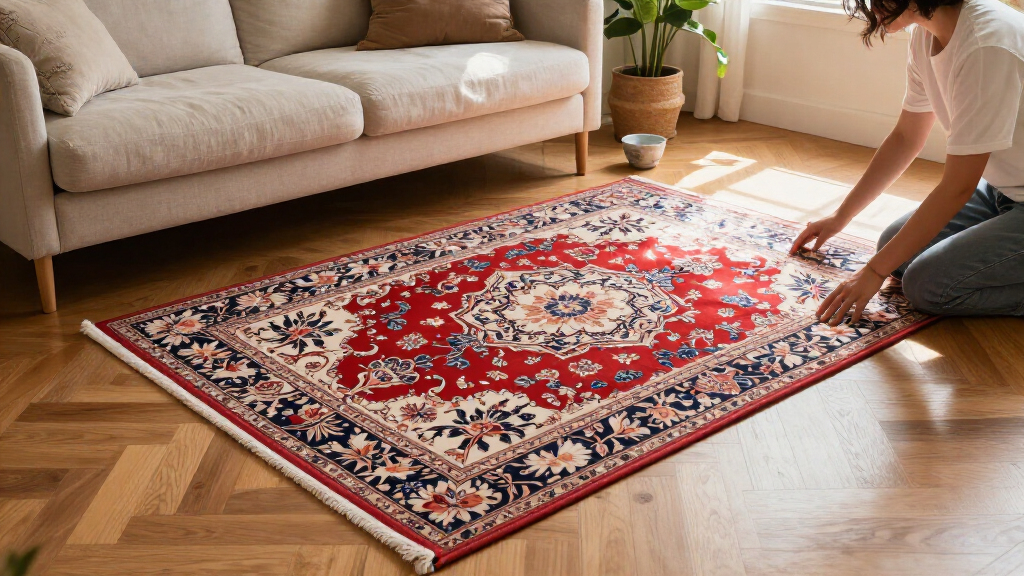
I ranked these options by how directly they answer the phrase Hereke pattern silk rug, not by treating every floral rug as a silk equivalent. Material and construction came first: hand-knotted silk ranks ahead of a machine-made polyester rug when the buyer’s main goal is a silk Hereke piece. I also considered the stated origin and period where supplied, since the Turkish antique has a more specific history than the two rugs described as dating to the 1980s.
Size and daily practicality shaped the rest of the order. A 6′ x 9′ rug serves a different room role from a compact accent, but its larger coverage cannot make up for its lack of silk when judged against this query. I noted pile information, backing, weight, palette, and care details as well. Missing information is not a reason to assume a feature is present: where the listings do not specify maintenance, pile height, or provenance detail, I treat that as an unresolved question for the buyer.
The ranking is therefore a fit-based guide, not a claim that one rug suits every room. The antique takes the lead for material and stated Turkish history; the Chinese hand-knotted option follows for silk construction and more usable small scale; the Turkish compact rug suits a narrow accent role; and the Apollo is included as a practical pattern alternative rather than a silk substitute.
| yilong hereke pattern silk rug | Origin | Backing | Construction |
|---|---|---|---|
| Antique Hereke Floral Silk Rug | Turkey | Silk | Handmade, hand-knotted |
| 2’8" x 4’1" Hand-Knotted Chine | — | Silk | Handmade, hand-knotted |
| Hand-Knotted Silk Turkish Here | Hereke, Turkey | Silk | Handmade, hand-knotted |
| Well Woven Apollo Serapi Herek | — | Cotton and recycled textile | Machine made |
Factors to Consider When Choosing Yilong Hereke Pattern Silk Rug
I would begin by deciding whether the word “silk” is a firm requirement or whether a Hereke-inspired floral look is enough. These four rugs split into three hand-knotted silk choices and one larger machine-made polyester alternative, so material preference changes the shortlist immediately.Silk Hereke or Hereke-inspired pattern?
The antique Turkish rug and both compact hand-knotted rugs are described as silk, including their backings. The Well Woven Apollo is instead polyester and chenille, with a floral design described as Hereke-inspired. That makes it the size-and-practicality choice, not a silk equivalent. I would use the material distinction as the first filter: if silk and hand-knotting are central to the purchase, compare the first three; if broad coverage matters more, consider the Apollo with its material tradeoff clearly in view.
Read origin and period details carefully
The listings provide different levels of provenance information. The antique is described as Turkish and dated 1910–1920, while the smallest silk rug is described as handmade in Hereke, Turkey, from the 1980s. The Chinese rug has a Hereke design but lists China as its country of origin. I would not assume that a design label proves a particular place of manufacture. If origin or age affects your decision, ask the seller what documentation or close-up details are available; the supplied descriptions alone do not settle every provenance question.
Match dimensions to the job
The size range is unusually wide. The Apollo’s 6′ x 9′ footprint is the only one suited to broad room coverage. The antique’s 48 x 63 inches creates a medium decorative area, while the Chinese rug at 2’8″ x 4’1″ works better as an accent. The Turkish rug at 1’10” x 2’6″ is a genuinely compact piece. I recommend taping out each rug’s dimensions on the floor before choosing, especially for the two smallest options; a silk rug can be visually striking yet disappear in a larger room.
Balance pile and care against daily traffic
Silk is the more delicate material in this lineup, and the silk listings do not provide detailed cleaning procedures. The Chinese example is identified as high pile, while the Turkish compact rug has no pile height supplied. The antique has a stated 0.5-inch pile. By comparison, the Apollo’s low pile is described as stain resistant, but it remains spot clean only and is not water resistant. I would keep any rug away from regular spills and confirm cleaning guidance before placing a silk piece in an active household.
Check the actual rug details before purchase
Product descriptions are not a substitute for inspecting a specific rug. For the antique, ask about the condition of the silk, how the sheen varies across the field, and whether the pearl details are intact. For the two 1980s rugs, request current images that show the pile, backing, edges, and any wear; the general condition statement does not show those details. For the Apollo, verify color and dimensions against your room and remember that stain resistance does not mean the rug can be soaked or machine washed. These checks matter most when listings leave care or condition questions unanswered.
Frequently Asked Questions
Which option is the closest match for a silk Hereke rug?
The Antique Hereke Floral Silk Rug is the closest match if you want a Turkish, hand-knotted silk piece with a stated 1910–1920 period. The compact Turkish rug is also described as handmade in Hereke with silk construction, but it is much smaller and dated to the 1980s. The Chinese rug uses a Hereke design but lists China as its origin, while the Apollo is a polyester floral alternative rather than a silk rug.
Is the Well Woven Apollo made from silk?
No. Its listed materials are polyester and chenille, and its construction is machine made. The Apollo is included because its soft-blue floral design is Hereke-inspired and its 6′ x 9′ size serves a different room need. Buyers who require actual silk should compare the three hand-knotted silk listings instead.
Which rug is best for a small accent area?
The Turkish Hand-Knotted Silk Hereke Rug is the most compact at 1’10” x 2’6″, so it suits a very limited display area. If you want more floor coverage while keeping a small-rug format, the Chinese Silk Hereke Rug measures 2’8″ x 4’1″. I would measure the intended location first, since neither is a room-sized rug.
Does the Apollo’s stain resistance mean it is waterproof or washable?
No. The listing explicitly says the Apollo is not water resistant and gives spot cleaning as its care method. Stain resistance may help with some everyday marks, but it does not make the rug suitable for soaking or machine washing. I would follow the listed spot-clean guidance and avoid assuming that spills can be rinsed away without risk.
What should I ask about before buying one of the silk rugs?
I would request recent photographs of the actual rug, including its pile, edges, backing, and any visible wear, and ask for specific cleaning guidance. For the antique, ask how the sheen and pearl details appear across the field; for the two 1980s pieces, confirm the condition and details not supplied, such as pile height or color. If origin and age matter, ask what documentation supports those descriptions.
Conclusion
For the closest match to a traditional Hereke pattern silk rug, I recommend the Antique Hereke Floral Silk Rug: its stated Turkish origin, hand-knotted silk build, period, and detailed palette make it the strongest overall fit, provided you can accommodate its weight and careful handling. Choose the Chinese Silk Hereke Rug if you want hand-knotted silk in a more adaptable accent size and are comfortable with its Chinese origin. The tiny Turkish rug makes sense for a tightly defined display spot where Hereke origin matters more than coverage.
If your priority is furnishing a larger area with a low-profile floral rug rather than owning silk, the Well Woven Apollo Serapi is the practical pattern alternative; its polyester build and spot-clean-only care distinguish it from the silk options. My short version: pick by material first, then check origin, dimensions, and care. That order prevents a large, attractive look-alike from being mistaken for a hand-knotted silk rug.