TL;DR
Three interior designers offer practical advice on using window treatments to affect a room’s proportions and finish. Their guidance covers high rod placement, floor-length curtains, hardware, and choosing fabric suited to sunlight and use.
Interior designers Miles Redd, Jan Showers and Marshall Watson have shared guidance on how to select and hang window treatments, arguing that curtains can shape a room’s proportions as well as cover a window. Their recommendations address rod height, curtain length, hardware and fabric, offering homeowners specific choices to weigh before ordering custom drapes or shades.

Get furniture and decor delivered free with Prime
- Fast, free delivery on millions of items
- Prime Video, Amazon Music and more included
- Member-only deals all year
The designers describe curtains as part of a room’s architecture, not simply a covering, reflecting an interior designer’s perspective. Watson says they can be used to make a ceiling appear higher or emphasize an existing feature. Showers similarly describes drapery as a way to add texture and finish. Redd, who works at New York design firm Redd Kaihoi, says the relationship between fabric, hardware and styling determines the overall effect.
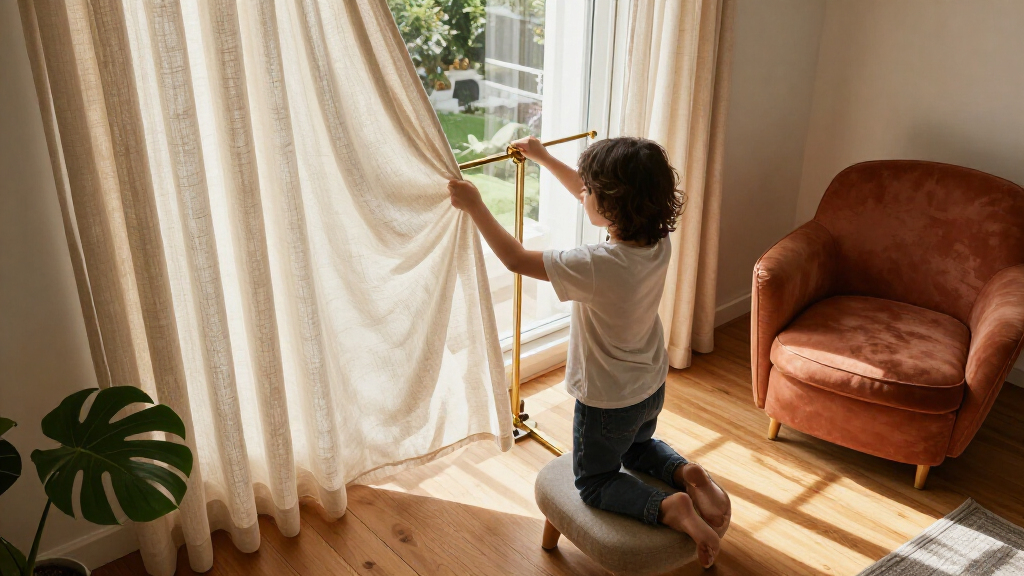
For placement, the designers recommend hanging curtain poles as high as practical, rather than directly above the window frame. Redd says a low rod can leave an unadorned strip of wall between the window and ceiling, making a room feel smaller. Watson suggests using a high pole or valance and a Roman or translucent shade to visually connect the ceiling area with the top of the window.
On length, Watson favors curtains that just touch the floor or break by about an inch, while Showers prefers a hem barely clear of the floor. Both caution against curtains that are conspicuously short or drag heavily. Watson notes that apron-length curtains can suit some casual rooms, such as cottages. The source also advises considering how much sunlight a room receives: lining may help filter or block sun and protect delicate material, while an unsuitable fabric may stretch or deteriorate.
Dress windows with a designer’s eye
Curtains shape a room’s proportions, texture and finish. Plan the rod, hem, hardware and fabric together for the way each room is used.
Start with placement
A higher rod can make a room feel taller; the right position depends on the window and ceiling.
Hang the pole as high as practical rather than directly above the window frame.
Aim for floor length or barely clear of the floor; casual rooms may suit apron length.
Consider fabric, rings and rod together to shape the finished look.
Let the room guide the choice
The designers offer preferences, not universal rules.
Connect wall and window
A high pole or valance can visually link the ceiling area with the window.
Consider exposure
Lining may filter or block sunlight and help protect delicate fabric.
Treat hardware as part of the design
Poles and rings influence the overall effect alongside fabric and styling.
Before placing an order
Check the needs of your own window and room.
- Decide how much light control the room needs.
- Check sunlight exposure and whether the fabric needs lining.
- Confirm window and ceiling measurements.
- Ask the supplier or workroom how the fabric will hang over time.
How Curtains Change Room Proportions
The advice matters because window treatments affect more than privacy and light control. Rod height and curtain length can change how tall a room appears, while fabric and trim influence its texture and formality. For readers planning a renovation or buying curtains, those decisions can make a room feel more cohesive without changing its windows or ceiling.
The designers’ recommendations are not presented as building rules or universal standards. They are professional preferences intended to guide decisions that depend on the room, the window and the fabric. The source’s practical point is to plan the treatment as a combination: a beautiful textile alone may not produce the intended look if the rod, rings or placement work against it.
Products Worth Considering

Ring Floodlight Cam 4K Pro (2nd Gen) Outdoor Security Camera

Samsung 55-Inch S90H OLED 4K UHD Smart TV Bundle with Full-Motion Mount and Surge Protector

Sonos Era 100 SL Compact Microphone-Free Speaker, Black
As an affiliate, we earn on qualifying purchases.
Three Designers, Different Approaches
The source brings together designers with distinct styles. Redd credits his former mentor, designer Bunny Williams, with teaching him how to combine antique valances with contemporary fabric and use inventive pelmet shapes. Showers, a Dallas-based designer and author, describes drapery as an architectural feature that gives a room texture. Watson, of Marshall Watson & Reid Deane Ganes, draws on traditional curtain-making and says careful handling of fabric can add grace.
The article also addresses a small piece of design terminology: a pelmet is a shaped or covered structure at the top of a window treatment, while a jabot is a decorative fabric accent often associated with formal drapery. The source frames these elements as options rather than requirements; its broader message is that a tailored shade or a more elaborate treatment can each suit a room when selected deliberately.
Hardware is another part of that decision. Redd says poles and rings can be as influential as the curtain itself. He and Showers favor a restrained combination in some settings: small rings and a slim bronze rod that returns to the wall, without finials. That is a design preference, not a fixed formula for every interior.
“In decorating, curtains are generally not used to cover the window. Curtains are there to correct the architecture of a room, to elongate a ceiling height or emphasize an element of the room.”
— Marshall Watson, interior designer
Choices Depend on Each Room
The source gives professional guidance, not measured evidence that one curtain style will work best in every home. It does not identify the publication date, provide product prices or compare the cost of custom and ready-made treatments. The fabric discussion is also incomplete in the supplied material, which ends mid-sentence, so no further care instructions or fabric recommendations can be confirmed from it.
Specific requirements will vary with sun exposure, window dimensions, ceiling height and intended light control. The article does not set out a full method for measuring windows or address every option, such as blackout systems, child-safety features or installation constraints. Readers should verify dimensions and fabric behavior with a supplier or workroom before placing a custom order.
Measure Before Ordering Drapes
The next step for homeowners is to apply the suggestions to their own windows: decide what the treatment needs to do, check how much sunlight reaches the room, and choose a practical rod position and hem length. Before purchasing, confirm window and ceiling measurements, ask whether the fabric needs lining, and discuss how it will hang over time with the retailer or workroom.
The designers’ guidance does not announce a new product or a change in industry standards. It is a set of recommendations for making window treatments work with a room’s proportions and use. The final choice remains specific to each home, and the supplied source does not give a date for any follow-up or additional advice.
Key Questions
Where should curtain rods be mounted?
The designers recommend mounting rods as high as practical, rather than immediately above the window. A higher placement can make the wall and room appear taller, though the right position depends on the window and ceiling.
How long should curtains be?
Watson favors curtains that touch the floor or break by about an inch; Showers prefers hems that sit just barely above it. Apron-length curtains may suit some casual rooms. The source discourages curtains that are obviously too short or heavily puddled.
Do curtains need to be lined?
Not always. The source says lining may be useful to filter or block sunlight or protect delicate fabric. The decision depends on exposure, the material and the desired level of light control.
Does curtain hardware affect the finished look?
Yes, according to Redd: poles and rings work with the fabric and styling to shape the overall effect. He and Showers favor a slim rod and small rings for some settings, but that is a design preference, not a rule.
Source: veranda.com