This guide helps students organize their dorm room using storage bins. You will learn how to select, arrange, and label bins to create a tidy, functional space. Suitable for beginners, this process takes about 30 to 60 minutes and results in a clutter-free environment that’s easy to maintain.

Get furniture and decor delivered free — and shop member deals
- Fast, free delivery on millions of items
- Access to Prime Big Deal Days deals on October 6–7
- Prime Video, Amazon Music and more included

Budding Joy 95L Under Bed Storage Containers, 4 Pack Closet Organizers Grey
- ✔ Material: Non-woven fabric + PVC
- ✔ Capacity: 95L / 24 gallons
- ✔ Dimensions: 39 x 20 x 7 inches

Amazon Basics Collapsible Fabric Storage Cubes Organizer with Handles, 10.5 x 10.5 x 11 inches, Beige, 6-Pack
- ✔ Item Dimensions: 10.5"L x 10.5"W x 11"H
- ✔ Item Weight: 1.1 pounds
- ✔ Unit Count: 6

YFXCVSL 4-Tier Plastic Storage Bins with Lid, 23QT, Stackable
- ✔ Capacity: 23 quarts per tier, 92 quarts total
- ✔ Dimensions: 15.35 x 11 x 8.27 inches per tier
- ✔ Material: Plastic (PP)
Difficulty: Beginner | Time: 30-60 minutes
What You’ll Need
Tools & Materials:
- Measuring tape or ruler
- Label maker or markers
- Scissors or box cutter (optional)
- Cleaning cloth
Knowledge:
- Basic understanding of space organization
- Ability to measure dimensions
Measure your closet, under-bed space, and available shelves before shopping for bins. Decide what items need to be stored and how often they are accessed.
Budding Joy 95L Under Bed Storage Containers, 4 Pack Closet Organizers Grey
<p>This set of four <strong>large capacity under bed containers</strong> stands out for its impressive 95-liter volume, making it perfect for seasonal clothing, bedding, or bulky toys. Its <strong>breathable non-woven fabric with clear PVC windows</strong> allows easy item identification without opening each box. Compared with smaller or collapsible options, these containers offer more space but lack rigid supports, meaning they might become misshapen over time. Reinforced handles add durability for frequent access, yet their collapsible design limits shape retention. They are ideal for students who need to maximize under-bed storage but are less suited for heavier, everyday items.</p>
Pros:
- Massive 95L capacity for versatile storage
- Breathable fabric keeps items fresh
- Clear PVC windows for easy identification
- Reinforced handles for durability
Cons:
- Lacks rigid supports, may lose shape
- Collapsible fabric can affect stability over time
- Limited to under bed or similar spaces
Best for: Students needing large, out-of-the-way storage for seasonal or bulky items
Not ideal for: Those who need rigid, stackable boxes or plan to store heavy items regularly
Bottom line: Best suited for maximizing under-bed storage with large, lightweight items, but less ideal for heavy-duty use.
“Best suited for maximizing under-bed storage with large, lightweight items, but less ideal for heavy-duty use.”
Amazon Basics Collapsible Fabric Storage Cubes Organizer with Handles, 10.5 x 10.5 x 11 inches, Beige, 6-Pack
<p>The <strong>Amazon Basics fabric cubes</strong> excel in offering flexible, portable storage for clothing, toys, or office supplies. Their <strong>collapsible design</strong> makes them easy to tuck away when not in use, and handles facilitate transport around the dorm. Compared to rigid plastic bins, these are lighter and more aesthetically adaptable, but they support only up to 5 pounds, limiting their use for heavier items. They work well as open-top bins or in compatible cube storage units, but are less suitable for stacking without additional reinforcement. This pick makes the most sense for students who value lightweight, versatile storage that can be moved easily.</p>
Pros:
- Set of six versatile fabric cubes with handles
- Collapsible for space-saving storage
- Lightweight but durable fabric
- Breathable material prevents odors
Cons:
- Supports only up to 5 lbs per cube
- Not designed for stacking or heavy-duty use
- May not fit all cube organizers
Best for: Students seeking flexible, lightweight storage for everyday items
Not ideal for: Heavy or stacked storage needs, or for storing items over 5 lbs
Bottom line: Ideal for lightweight, portable storage needs, but not suited for heavy or stacked items.
“Ideal for lightweight, portable storage needs, but not suited for heavy or stacked items.”
YFXCVSL 4-Tier Plastic Storage Bins with Lid, 23QT, Stackable
<p>This <strong>4-tier plastic storage system</strong> offers a substantial total capacity of 92 quarts, making it perfect for organizing craft supplies, makeup, or household essentials. Its <strong>stackable design with wheels</strong> provides mobility and space efficiency, while dual-opening lids enhance accessibility. Compared to fabric options, this plastic bin is more durable for heavier or more frequently accessed items, though the plastic material may feel less premium and could wear over time. Assembly is required, which might be a drawback for some students, but the overall capacity and mobility make it a flexible choice for multi-purpose organization. It’s best suited for students who need large, accessible storage with easy movement.</p>
Pros:
- Large 92-quart capacity for various items
- Wheels with locking feature for mobility
- Stackable design saves space
- Dual opening lids for easy access
Cons:
- Plastic may be less durable long-term than metal
- Wheels might wear with heavy use
- Assembly required
Best for: Students needing large, stackable, and mobile storage solutions
Not ideal for: Those looking for lightweight or aesthetic storage solutions, or minimal assembly
Bottom line: Best for students who prioritize high capacity and mobility, accepting some assembly time and heavier weight.
“Best for students who prioritize high capacity and mobility, accepting some assembly time and heavier weight.”
As an Amazon Associate we earn from qualifying purchases.
Before You Start
Clear the area where you’ll be working. Remove any clutter or items that may obstruct organization. Have your measurement tools ready to choose appropriately sized bins.
Step-by-Step Instructions
Step 1: Assess your storage needs
Make a list of items you need to store, such as clothing, toiletries, school supplies, or snacks. Note their sizes and how often you need access to each category.
Tip: Group similar items together to simplify bin selection and retrieval.
Check: You have a clear list of items categorized by type and size, ready for bin selection.
Step 2: Measure available space
Use a measuring tape to determine the dimensions of your closet, under-bed area, shelves, or designated storage zones. Record these measurements.
Tip: Double-check measurements for accuracy to avoid purchasing bins that won’t fit.
Check: You have accurate measurements for all storage areas, guiding your bin size choices.
Step 3: Select appropriate storage bins
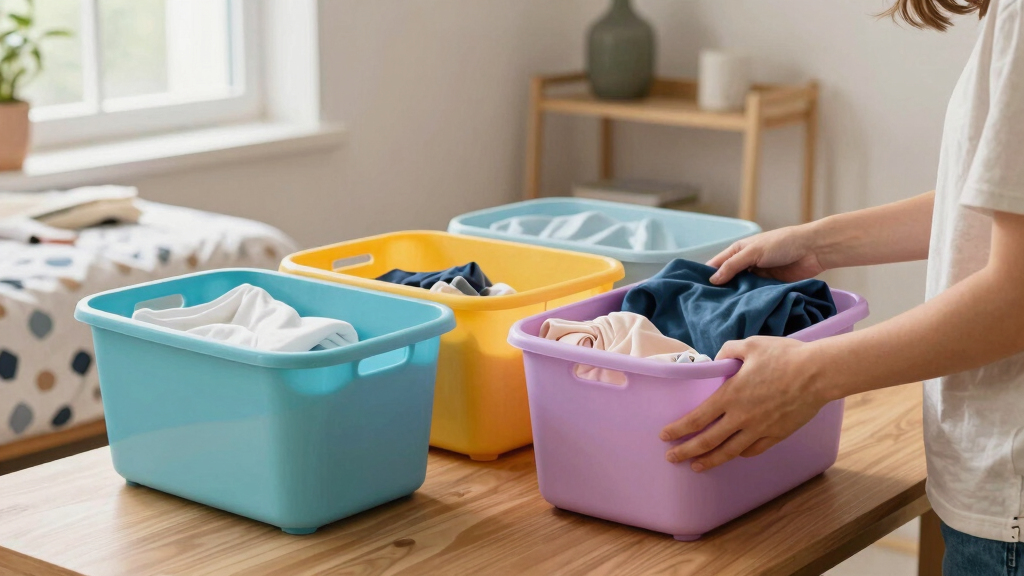
Choose bins that fit your measured spaces, considering the size of items to be stored. Opt for clear plastic bins for visibility or opaque ones for privacy. Consider stackable designs for vertical space.
Tip: Avoid overly large bins for small items to prevent wasted space; use smaller bins for tiny items.
Check: Bins fit comfortably in your designated storage areas and match your item sizes.
Step 4: Clean and prepare storage areas
Wipe down shelves, closet corners, or under-bed spaces with a cleaning cloth to create a fresh environment before placing bins.
Tip: Ensure areas are dry before placing bins to prevent mold or damage.
Check: Storage spaces are clean, dry, and ready for bin placement.
Step 5: Organize items into bins
Place items into bins according to your categories. Use labels or markers to identify contents clearly. Fill bins so they are full but not overstuffed.
Tip: Use smaller containers within larger bins for tiny items or frequently used supplies.
Check: Items are sorted in bins, labeled, and easily accessible.
Step 6: Arrange bins in designated spaces
Position bins in their assigned locations—under the bed, on shelves, or in closets—based on your earlier measurements. Stack bins where possible to save space.
Tip: Place frequently accessed bins at the front or top for easy reach.
Check: Bins are neatly arranged, stable, and accessible, with clear pathways.
Step 7: Label each bin
Use a label maker or markers to clearly mark each bin’s contents. Attach labels to the front for quick identification.
Tip: Use color-coded labels for different item categories if desired for faster recognition.
Check: All bins are labeled correctly, making retrieval simple.
Common Mistakes to Avoid
- Choosing bins that do not fit the storage spaces — Measure all areas first and select bins that match the measurements closely.
- Overfilling bins, causing difficulty in lifting or closing lids — Fill bins to capacity but leave room for lids to close properly without straining.
- Not labeling bins, leading to difficulty finding items — Always label bins immediately after filling to maintain organization.
- Stacking bins unevenly or insecurely — Ensure bins are stable and stack evenly, avoiding toppling hazards.
Troubleshooting
Problem: Bins don’t fit or are too tight in storage space
Solution: Re-measure the space and choose smaller or differently shaped bins. Consider removing or rearranging other items to create space.
Problem: Items are difficult to access or find
Solution: Rearrange bins so frequently used items are in the most accessible locations. Add labels or organize contents for easier retrieval.
Problem: Bins are unstable or topple when stacked
Solution: Use interlocking or stackable bins designed for stability. Avoid overstacking beyond safe height.
What Success Looks Like
The final setup features neatly arranged, labeled bins that fit well in designated spaces, with easy access to frequently used items and a visibly organized layout.
Next Steps
Regularly review and tidy your bins weekly to maintain organization. Reassess your storage needs each semester and replace or add bins as your items or space change. Use the labels as a reference for quick restocking or reorganization.
Frequently Asked Questions
What size storage bins should I buy?
Choose bins that fit your storage areas and suit your items’ sizes. Measure your space and select bins that leave some space for lids or stacking stability.
How do I prevent bins from tipping over when stacked?
Use stackable bins with interlocking features or place heavier bins at the bottom to improve stability. Avoid stacking beyond safe heights.
Can I use fabric bins instead of plastic?
Yes, fabric bins can work but may not be as durable or stackable. Ensure they fit your space and are sturdy enough for your items.
How often should I reorganize my dorm room bins?
Perform a thorough review and reorganization at least once each semester or when your storage needs change.
Fall Picks
fall essentials
As an affiliate, we earn on qualifying purchases.