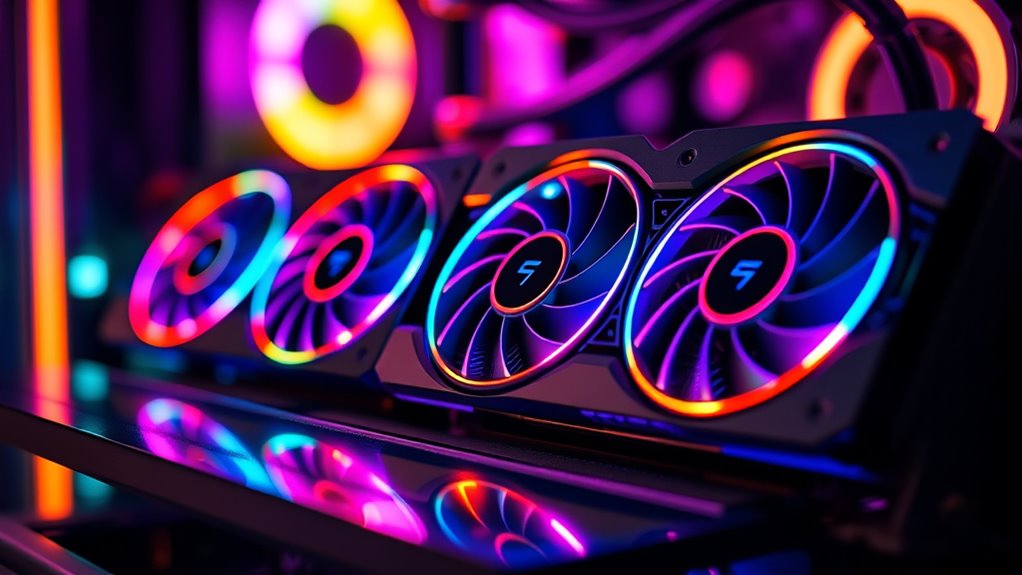

For gamers seeking the highest performance and cutting-edge features, premium graphics cards are essential. The PNY NVIDIA GeForce RTX 5080 Epic-X stands out for its exceptional overclocking potential and cooling, making it ideal for enthusiasts. The ASUS Prime AMD Radeon RX 9070 XT offers excellent value with robust performance, while the EVGA GeForce RTX 3090 FTW3 Ultra remains a powerhouse for demanding titles. Choosing among these options involves balancing raw power, thermal management, and price. Continue reading for a comprehensive breakdown of each model and what makes them unique.
Complete the kit


Key Takeaways
- The top-ranked cards balance raw performance with cooling solutions and build quality.
- Pricing varies significantly, with premium features often adding substantial cost.
- Overclocking capabilities are a common trait among the best options, but they come with increased heat output.
- Memory size and type (GDDR6 vs GDDR7) influence future-proofing and performance ceilings.
- Compact designs are available but often sacrifice some cooling efficiency or performance headroom.
| PNY NVIDIA GeForce RTX 5080 Epic-X ARGB OC Triple Fan Graphics Card |  | Best Overall | Memory: 16GB GDDR7 | Memory Interface: 256-bit | Boost Speed: 2775 MHz | VIEW ON AMAZON | See Our Full Breakdown |
| ASUS Prime AMD Radeon RX 9070 XT 16GB GDDR6 OC Edition Graphics Card |  | Best Value Pick | Graphics Coprocessor: AMD RX9070 | RAM: 16 GB | GPU Clock Speed: 4000 MHz | VIEW ON AMAZON | See Our Full Breakdown |
| EVGA GeForce RTX 3090 FTW3 Ultra Gaming Graphics Card |  | Best for Creative and Demanding Tasks | Memory: 24GB GDDR6X | CUDA Cores: 10496 | Boost Clock: 1800MHz | VIEW ON AMAZON | See Our Full Breakdown |
| GIGABYTE GeForce RTX 5070 Gaming OC 12G Graphics Card |  | Best for Mid-Range Enthusiasts | Memory: 12GB GDDR7 | Memory Interface: 192-bit | Architecture: NVIDIA Blackwell | VIEW ON AMAZON | See Our Full Breakdown |
| Sapphire Nitro+ AMD Radeon RX 9070 XT Gaming OC Graphics Card, 16GB GDDR6 |  | Best for Versatile Gaming and Connectivity | Memory Size: 16 GB | Memory Interface: 256-bit | Output: 2 x HDMI, 2 x DisplayPort | VIEW ON AMAZON | See Our Full Breakdown |
| ASUS TUF Gaming GeForce RTX 5080 16GB GDDR7 OC Edition Graphics Card |  | Best Overall for High-End Gaming and Professional Use | Graphics Coprocessor: NVIDIA GeForce RTX 5080 | RAM: 16 GB | GPU Clock Speed: 2730 megahertz | VIEW ON AMAZON | See Our Full Breakdown |
| GIGABYTE GeForce RTX 5080 Gaming OC 16G Graphics Card |  | Best Value for High-End Performance with Advanced Cooling | Memory: 16GB GDDR7 | Memory Interface: 256-bit | Architecture: NVIDIA Blackwell | VIEW ON AMAZON | See Our Full Breakdown |
| GIGABYTE Radeon RX 9070 XT Gaming OC ICE 16G Graphics Card |  | Best for RGB Aesthetics and Cooling with High Performance | Memory: 16GB GDDR6 | Memory Interface: 256-bit | PCIe Support: PCIe 5.0 | VIEW ON AMAZON | See Our Full Breakdown |
| ASUS Dual NVIDIA GeForce RTX 5060 Ti 16GB GDDR7 OC Edition Graphics Card |  | Best for AI-Enhanced Gaming and Modern Connectivity | GPU Architecture: NVIDIA Blackwell | Memory: 16GB GDDR7 | OC Mode Clock: 2632 MHz | VIEW ON AMAZON | See Our Full Breakdown |
| ASUS Dual NVIDIA GeForce RTX 5060 8GB GDDR7 OC Edition |  | Best for Budget-Conscious High-Performance Gaming | Memory: 8GB GDDR7 | Architecture: NVIDIA Blackwell | Boost Clock: 2565 MHz | VIEW ON AMAZON | See Our Full Breakdown |
| premium graphics cards for gaming rig | Memory | Memory Interface |
|---|---|---|
| PNY NVIDIA GeForce RTX 5080 Ep | 16GB GDDR7 | 256-bit |
| ASUS Prime AMD Radeon RX 9070 | — | — |
| EVGA GeForce RTX 3090 FTW3 Ult | 24GB GDDR6X | — |
| GIGABYTE GeForce RTX 5070 Gami | 12GB GDDR7 | 192-bit |
| Sapphire Nitro+ AMD Radeon RX | — | 256-bit |
| ASUS TUF Gaming GeForce RTX 50 | — | — |
| GIGABYTE GeForce RTX 5080 Gami | 16GB GDDR7 | 256-bit |
| GIGABYTE Radeon RX 9070 XT Gam | 16GB GDDR6 | 256-bit |
| ASUS Dual NVIDIA GeForce RTX 5 | 16GB GDDR7 | — |
| ASUS Dual NVIDIA GeForce RTX 5 | 8GB GDDR7 | — |
More Details on Our Top Picks
PNY NVIDIA GeForce RTX 5080 Epic-X ARGB OC Triple Fan Graphics Card
This model stands out for delivering cutting-edge gaming performance with its 16GB GDDR7 memory and a boost speed of 2775 MHz, making it ideal for enthusiasts who want top-tier graphics. Compared with the GIGABYTE RTX 5070 Gaming OC, it offers a faster clock speed and larger memory, but at a likely higher price and with a bigger size that may not fit all cases. The triple-fan cooling and ARGB lighting ensure both effective heat dissipation and aesthetic appeal, perfect for build enthusiasts who prioritize looks alongside performance. However, its size could be a barrier for smaller cases, and the high cost might deter casual gamers or those on a budget. Best for gamers and creative professionals seeking flagship performance without compromise.
Pros:- Exceptional performance with 16GB GDDR7 memory and high boost clock
- Supports advanced AI, ray tracing, and creative workflows
- ARGB lighting and triple fans for cooling and visual flair
Cons:- Large size may require a spacious case
- High cost might be prohibitive for budget-conscious buyers
Best for: High-end gamers and creative professionals who need maximum graphics power and aesthetic customizability
Not ideal for: Casual gamers or users with compact cases, due to its large size and premium price
- Memory:16GB GDDR7
- Memory Interface:256-bit
- Boost Speed:2775 MHz
- Architecture:Blackwell
- Video Outputs:HDMI, DisplayPort 2.1
- PCIe:5.0
- Slot Size:2.99-slot
Our verdict“This card makes the most sense for demanding users who prioritize raw performance and premium features over size and price.”
ASUS Prime AMD Radeon RX 9070 XT 16GB GDDR6 OC Edition Graphics Card
This card offers a compelling mix of performance and affordability, featuring 16GB GDDR6 memory and PCIe 5.0 support, making it an excellent choice for gamers who want high resolution gaming without the premium price tag of the PNY RTX 5080. While it doesn’t match the raw speed of the RTX 5080, its 4000 MHz GPU clock and high-resolution support up to 7680 x 4320 make it suitable for immersive gaming setups. The axial-tech fans and dual ball bearings provide reliable cooling, but the large 12.3-inch length and requirement for PCIe 5.0 may limit compatibility with older systems. This pick strikes a balance for those who want high performance without overspending. Best for gamers upgrading mid-range systems seeking premium features at a reasonable price.
Pros:- 16GB GDDR6 memory for demanding applications
- Supports high resolutions up to 7680 x 4320
- Effective cooling with axial-tech fans and dual bearings
Cons:- Requires PCIe 5.0 slot, which may not be available on older PCs
- Large size could limit compatibility with smaller cases
Best for: Gamers with PCIe 5.0 compatible motherboards looking for high-resolution gaming at a good value
Not ideal for: Users with older motherboards or smaller cases, due to size and PCIe 5.0 dependency
- Graphics Coprocessor:AMD RX9070
- RAM:16 GB
- GPU Clock Speed:4000 MHz
- Video Output Interface:DisplayPort 2.1a x 3, HDMI 2.1b
- Memory Type:GDDR6
- Interface:PCI-Express x16
- Maximum Resolution:7680 x 4320
Our verdict“This card hits the sweet spot for gamers seeking high performance and future-proofing without the highest price tag.”
EVGA GeForce RTX 3090 FTW3 Ultra Gaming Graphics Card
This card is best suited for users who need serious computing muscle, especially with its 24GB GDDR6X memory and 10496 CUDA cores, making it ideal for creative workflows and high-end gaming. Compared to the GIGABYTE RTX 5070, it offers more CUDA cores and memory, but at a significantly higher price and power consumption. The triple-fan cooling system and ARGB lighting provide both effective heat management and aesthetic customization, suitable for builders who want a showpiece that can handle intensive tasks. Its size and power demands, however, may exclude those with smaller cases or limited power supplies. Best for professionals and enthusiasts who demand maximum performance regardless of cost or size.
Pros:- Enormous 24GB GDDR6X memory for demanding creative workflows
- High CUDA core count for intensive tasks
- Triple fan cooling and ARGB lighting for aesthetics and thermal management
Cons:- Very high price point
- Large size and power consumption may limit compatibility
Best for: Creative professionals and hardcore gamers needing extensive GPU memory and processing power
Not ideal for: Casual users or those with tight space and budget constraints, due to size and cost
- Memory:24GB GDDR6X
- CUDA Cores:10496
- Boost Clock:1800MHz
- Fans:3
- Lighting:ARGB LED
- Backplate:Metal
Our verdict“This GPU is a premier choice for those who require uncompromising performance in professional and gaming applications, accepting the premium cost and size.”
GIGABYTE GeForce RTX 5070 Gaming OC 12G Graphics Card
This card offers solid performance with NVIDIA Blackwell architecture and DLSS 4, making it a strong choice for gamers who want high-quality visuals without the expense of flagship models like the PNY RTX 5080. Its 12GB GDDR7 memory and PCIe 5.0 support make it suitable for demanding titles and future-proofing, but it’s less powerful than the RTX 5080 or the EVGA RTX 3090 in raw specs. The WINDFORCE cooling system ensures thermal stability during extended gaming sessions, though its power consumption may be high and it requires a PCIe 5.0 slot, which could limit upgrades for older systems. This makes it appealing for serious gamers who don’t need absolute cutting-edge speed. Best for gamers upgrading from mid-tier cards seeking a balance of performance and cost.
Pros:- NVIDIA Blackwell architecture with DLSS 4 support
- 12GB GDDR7 memory suitable for modern titles
- Effective WINDFORCE cooling system
Cons:- High power consumption
- Requires PCIe 5.0 slot, limiting compatibility
Best for: Enthusiast gamers with PCIe 5.0 systems looking for capable performance at a reasonable price
Not ideal for: Owners of older systems or smaller cases, due to power and size considerations
- Memory:12GB GDDR7
- Memory Interface:192-bit
- Architecture:NVIDIA Blackwell
- DLSS:4
- PCIe:5.0
Our verdict“This card provides a capable performance boost for serious gamers looking to upgrade without stepping into flagship territory.”
Sapphire Nitro+ AMD Radeon RX 9070 XT Gaming OC Graphics Card, 16GB GDDR6
This card makes the list for its balanced approach, with 16GB GDDR6 memory and multiple output options including HDMI and DisplayPort, making it well-suited for gamers who want flexible connectivity. It’s less specialized in raw speed than the EVGA RTX 3090, but its broad compatibility and professional-grade features make it a good choice for high-performance gaming and demanding graphics tasks. The limited specifications on cooling and power requirements mean it may not be suitable for extreme overclocking or compact builds, but it offers reliable performance for most gaming setups. It’s an appealing option for those wanting a high-quality AMD card with broad outputs. Best for gamers who need versatile connectivity and solid performance in a balanced package.
Pros:- 16GB GDDR6 memory for demanding applications
- Multiple output options including HDMI and DisplayPort
- Designed for versatile high-performance gaming
Cons:- Limited detailed cooling and power specs
- No overclocking-focused features mentioned
Best for: Gamers requiring multiple output options and high-performance AMD graphics for demanding titles
Not ideal for: Users seeking the absolute highest speed or with strict space or cooling constraints
- Memory Size:16 GB
- Memory Interface:256-bit
- Output:2 x HDMI, 2 x DisplayPort
Our verdict“This GPU is a versatile choice for gamers who prioritize connectivity and balanced performance over the absolute fastest speeds.”
ASUS TUF Gaming GeForce RTX 5080 16GB GDDR7 OC Edition Graphics Card
This card stands out for its combination of raw power and durability, making it ideal for gamers who push their rigs to the limits or professionals needing serious GPU performance. Compared with the GIGABYTE Radeon RX 9070 XT, it offers higher clock speeds and a more robust cooling system, but its size and price are significant considerations. The three axial-tech fans and military-grade components ensure longevity, while the support for resolutions up to 7680×4320 caters to demanding creative workflows. However, its large footprint requires a spacious case and consumes substantial power, which could mean higher operational costs. Overall, this model makes the most sense for users who prioritize top-tier performance and build quality over budget constraints.
Pros:- High-performance GPU with 16GB GDDR7 memory
- Robust cooling system with three axial-tech fans
- Durable build with military-grade components
- Supports ultra-high resolutions up to 7680×4320
Cons:- Large size may not fit smaller cases
- High power consumption and premium price
Best for: Enthusiasts who want the ultimate gaming and professional graphics performance without compromise
Not ideal for: Casual gamers or users with small or budget-constrained cases, due to its size and premium price
- Graphics Coprocessor:NVIDIA GeForce RTX 5080
- RAM:16 GB
- GPU Clock Speed:2730 megahertz
- Video Output Interface:DisplayPort 2.1a x3, HDMI 2.1b x2
- Graphics Ram Type:GDDR7
- Item Dimensions:13.7″L x 5.7″W
Our verdict“This card is best suited for serious gamers and professionals demanding top-tier performance and durability, accepting larger size and higher costs.”
GIGABYTE GeForce RTX 5080 Gaming OC 16G Graphics Card
This model offers a compelling balance of performance and features, especially with its use of the NVIDIA Blackwell architecture and PCIe 5.0 interface. Compared to the ASUS TUF RTX 5080, it may have a slightly simpler cooling system, but the WINDFORCE technology ensures effective thermal management during extended gaming sessions. Its 16GB GDDR7 memory supports demanding titles and creative tasks, while PCIe 5.0 support future-proofs the system. Its main tradeoff is the need for a compatible PCIe 5.0 slot and potentially higher power draw, which could increase system complexity and costs. This pick is ideal for users seeking premium performance without the extra bulk or premium pricing of some larger models.
Pros:- Supports PCIe 5.0 for future compatibility
- 16GB GDDR7 memory for demanding workloads
- Effective WINDFORCE cooling system
Cons:- Requires PCIe 5.0 motherboard
- Potentially high power consumption and cost
Best for: Gamers and creators who want high performance with a more streamlined size and modern PCIe 5.0 support
Not ideal for: Owners of older motherboards without PCIe 5.0 slots or those sensitive to power consumption and upgrade costs
- Memory:16GB GDDR7
- Memory Interface:256-bit
- Architecture:NVIDIA Blackwell
- Cooling System:WINDFORCE
- Interface:PCIe 5.0
Our verdict“Ideal for high-performance users who need a modern, efficient GPU that balances power and cooling without excessive size.”
GIGABYTE Radeon RX 9070 XT Gaming OC ICE 16G Graphics Card
Compared with NVIDIA-based options like the ASUS Dual RTX 5060 Ti, this Radeon card offers a compelling mix of style and thermal efficiency. The 16GB GDDR6 memory supports AAA gaming and creative workflows, while the advanced WINDFORCE cooling with Hawk fans ensures thermal stability. The customizable RGB lighting adds flair, and its reinforced metal backplate provides durability. However, its size might demand a spacious case, and its premium features come at a higher price. The inclusion of dual BIOS and a reinforced structure makes it suitable for users who value aesthetics along with performance but might be overkill for casual or budget-conscious gamers.
Pros:- High-performance 16GB GDDR6 memory
- Effective cooling with WINDFORCE technology
- Customizable RGB lighting for aesthetics
- Reinforced metal backplate for durability
Cons:- Large size may not fit all cases
- Higher price point for premium features
Best for: Gamers who want a visually striking card with excellent cooling and durability for demanding titles
Not ideal for: Users with limited case space or those seeking a more subdued, budget-oriented GPU
- Memory:16GB GDDR6
- Memory Interface:256-bit
- PCIe Support:PCIe 5.0
- Cooling System:WINDFORCE with Hawk fans
- Features:RGB Lighting, Dual BIOS, Reinforced Structure
Our verdict“This card is perfect for gamers who prioritize style and thermal performance alongside high gaming capability.”
ASUS Dual NVIDIA GeForce RTX 5060 Ti 16GB GDDR7 OC Edition Graphics Card
This card excels in AI-driven gaming, thanks to NVIDIA’s DLSS 4 and 16GB GDDR7 memory, making it a strong choice for users who want cutting-edge AI features. Its axial-tech fan design ensures efficient cooling, rivaling the ASUS TUF RTX 5080 in thermal management but at a lower price point. Its 3-year warranty adds peace of mind for long-term reliability. Still, its high power requirements could be a concern for systems with limited capacity, and it might be expensive for gamers who don’t utilize AI features. Compared to larger, more expensive models, it offers a practical balance of performance and affordability for tech-savvy users.
Pros:- Supports DLSS 4 for AI performance
- Efficient axial-tech fan design
- 3-year warranty for reliability
- Supports latest HDMI and DisplayPort standards
Cons:- High power consumption
- Expensive relative to non-AI cards
Best for: Gamers and professionals interested in AI-enhanced features and reliable performance in a mid-range size
Not ideal for: Casual gamers or those with systems that can’t support high power draw, due to its high performance demands
- GPU Architecture:NVIDIA Blackwell
- Memory:16GB GDDR7
- OC Mode Clock:2632 MHz
- Interface:PCIe 5.0
- Features:DLSS 4, HDMI 2.1b, Axial-tech Fan
Our verdict“Best suited for users seeking advanced AI features and reliable performance without stepping into ultra-premium territory.”
ASUS Dual NVIDIA GeForce RTX 5060 8GB GDDR7 OC Edition
Compared with the 16GB variants, this ASUS Dual RTX 5060 offers a solid mix of performance and affordability, especially with 8GB GDDR7 memory that still handles demanding games well. Its axial-tech fan design provides effective cooling, similar to the higher-tier models like the ASUS Dual RTX 5060 Ti, but with a smaller memory buffer. The 3-year warranty adds confidence, but the limited detailed specs and high power demands might cause concern for those planning a long-term build. This card makes a strong case for gamers who want recent AI features and PCIe 5.0 support at a more accessible price point, but it may fall short for ultra-high-resolution or future-proof heavy workloads.
Pros:- Supports PCIe 5.0 for future compatibility
- High AI performance with 623 AI TOPS
- Efficient axial-tech fan design
- 3-year warranty
Cons:- Limited VRAM for very demanding applications
- Potentially high power draw for its class
Best for: Budget-conscious gamers who want recent tech features without sacrificing compatibility or performance
Not ideal for: Users aiming for maximum VRAM capacity or ultra-high-resolution workloads, due to its 8GB memory limit
- Memory:8GB GDDR7
- Architecture:NVIDIA Blackwell
- Boost Clock:2565 MHz
- Interface:PCIe 5.0
- Features:DLSS 4, HDMI 2.1b, Axial-tech Fan
Our verdict“Ideal for gamers seeking modern features and solid performance at a more accessible price point, with some limitations on VRAM and future-proofing.”

How We Picked
These graphics cards were selected based on a combination of performance benchmarks, build quality, cooling solutions, and feature sets. We prioritized models that deliver high frame rates at 4K resolution, offer stable overclocking potential, and include premium components. Value was considered relative to performance, ensuring that each pick offers a meaningful upgrade over mid-tier options. The ranking reflects a balance between cutting-edge features and practical usability for high-end gaming setups, helping buyers identify the most capable cards within the premium category.Factors to Consider When Choosing Premium Graphics Cards For Gaming Rigs
Choosing the right premium graphics card involves more than just raw power. Key factors include performance at your target resolution, cooling and noise levels, build quality, and future-proofing features. Understanding these elements helps avoid overpaying for unnecessary specs or selecting a card that doesn’t meet your gaming needs. The following sections highlight important considerations to guide your decision-making process.Performance and Resolution Targets
High-end gaming demands a graphics card capable of delivering smooth frame rates at your preferred resolution. For 4K gaming, look for cards with at least 16GB of memory and robust GPU cores. Models like the EVGA RTX 3090 excel here, but some 5070/5080 series cards also perform admirably at 1440p or 4K. Be wary of overestimating your needs; a card designed for 8K gaming may be overkill if your monitor maxes out at 1440p, leading to unnecessary expense.
Cooling and Noise Levels
Premium graphics cards often feature advanced cooling solutions, but these can come with tradeoffs in noise levels. Larger triple-fan designs tend to run cooler and quieter under load, making them ideal for long gaming sessions. Smaller or blower-style coolers might save space but often run louder and less efficiently. Consider your case airflow and noise tolerance when selecting a model to balance thermal performance and comfort.
Build Quality and Aesthetics
Premium cards typically feature high-quality materials and premium finishes, which contribute to durability and aesthetics. Features like RGB lighting, reinforced backplates, and robust power circuitry add to the visual appeal and longevity. However, these enhancements can increase cost and complexity. Evaluate whether the aesthetic features match your build’s style and whether the durability justifies the premium price.
Future-Proofing and Connectivity
For sustained performance, look for cards supporting the latest standards, such as PCIe 4.0/5.0 and HDMI 2.1 or DisplayPort 2.0. VR readiness and multi-monitor support are also important if you plan to expand your setup. The choice between GDDR6 and GDDR7 memory influences future compatibility and bandwidth, with GDDR7 offering potential performance gains for upcoming titles and workloads.
Price and Value Considerations
While premium cards command high prices, it’s crucial to weigh features against cost. Sometimes, a slightly lower-tier model offers nearly identical performance for a significantly better price. Conversely, investing in the latest generation or overclocked variants can provide a performance edge and longer lifespan. Avoid paying extra solely for branding or RGB features if those do not align with your priorities.
Frequently Asked Questions
Is it worth paying extra for overclocked models?
Overclocked versions of premium graphics cards often deliver higher frame rates and improved performance margins, especially in demanding titles. However, they typically generate more heat and noise, and the price premium can be substantial. If you have adequate cooling and value every frame, investing in an overclocked model makes sense. For more casual or budget-conscious gamers, standard editions often provide enough power without the added expense.
How long will a premium graphics card remain relevant?
High-end cards like these are designed to stay competitive for several years, thanks to their ample VRAM and advanced architectures. However, game requirements and software updates continually evolve, so future-proofing depends on choosing the latest generation and features like GDDR7 memory and PCIe 5.0 support. Regular driver updates and a solid cooling setup also extend the useful lifespan of these cards.
Should I prioritize raw performance or features like RGB and aesthetics?
For a premium gaming rig, performance should be your primary focus, especially if you aim for high resolutions and frame rates. Features like RGB lighting and design elements add personal flair but do not impact gaming performance. If aesthetics matter greatly to you, select a model that combines both high performance and your preferred style, but avoid sacrificing core capabilities for cosmetic enhancements.
Are dual-fan or triple-fan designs better?
Triple-fan configurations generally offer superior cooling, which supports higher overclocking potential and quieter operation. They are better suited for high-performance setups where thermal management is critical. Dual-fan cards are more compact, easier to fit into smaller cases, but may run hotter and louder under load. Choose based on your case size, cooling needs, and noise preferences.
What should I consider when choosing a card for multi-monitor gaming?
Multi-monitor setups demand higher bandwidth and multiple outputs. Ensure the card supports HDMI 2.1 or DisplayPort 2.0, and check the number of available ports. Larger VRAM capacities are beneficial for rendering multiple screens at high resolutions. Additionally, look for models with good multi-monitor support and driver stability to avoid issues during extended gaming sessions.
Conclusion
If you’re after the best overall performer for high-end gaming, the EVGA GeForce RTX 3090 FTW3 Ultra offers unmatched raw power. Budget-conscious enthusiasts aiming for premium features without the highest price might prefer the GIGABYTE GeForce RTX 5070 Gaming OC. For newcomers building a premium setup, the ASUS Dual NVIDIA GeForce RTX 5060 Ti provides a balanced mix of performance and affordability. Meanwhile, those seeking future-proofing and absolute top-tier specs should consider the ASUS TUF Gaming GeForce RTX 5080. Your choice ultimately depends on your gaming goals, budget, and case compatibility.